

Purdue Veterinary Medicine scholars involved in new bladder cancer research initiative
The striking similarities between invasive bladder cancer in dogs and humans have fueled research advances for more than three decades. Most of that work has looked at separate aspects of the disease — risk factors, early detection, symptoms, treatment and gene expression. But a new project at Purdue University that combines many types of available data in a “digital twin” model of bladder cancer may prove powerful enough to predict patient outcomes, starting with the probability of metastasis.
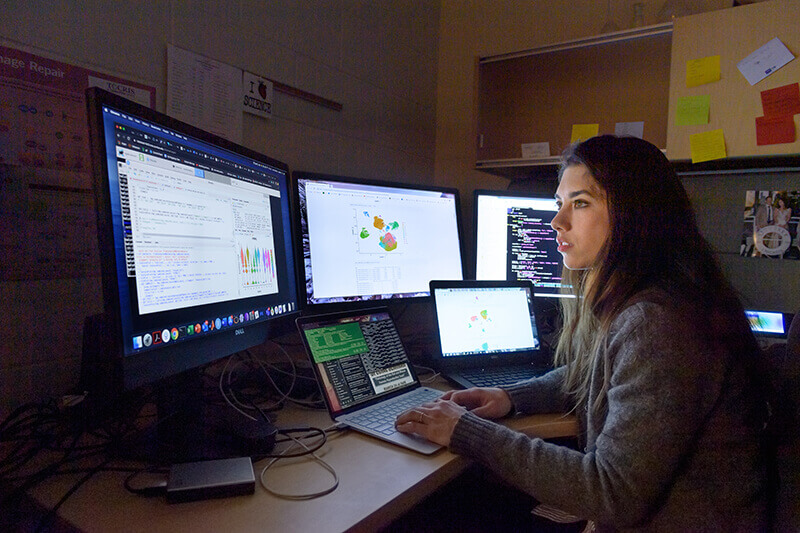
“We want to be able to look at a tissue sample from a patient and say, ‘This person’s tumor has these features that we’ve seen can predict metastasis with a reasonable degree of certainty, so we should treat that patient as aggressively as possible,’” said Nadia Lanman, PhD, a research associate professor of comparative pathobiology in the College of Veterinary Medicine and manager of the Collaborative Core for Cancer Bioinformatics. “We’re leveraging data from dogs to learn more about cancer in humans, which hopefully helps both our canine friends and human patients.”
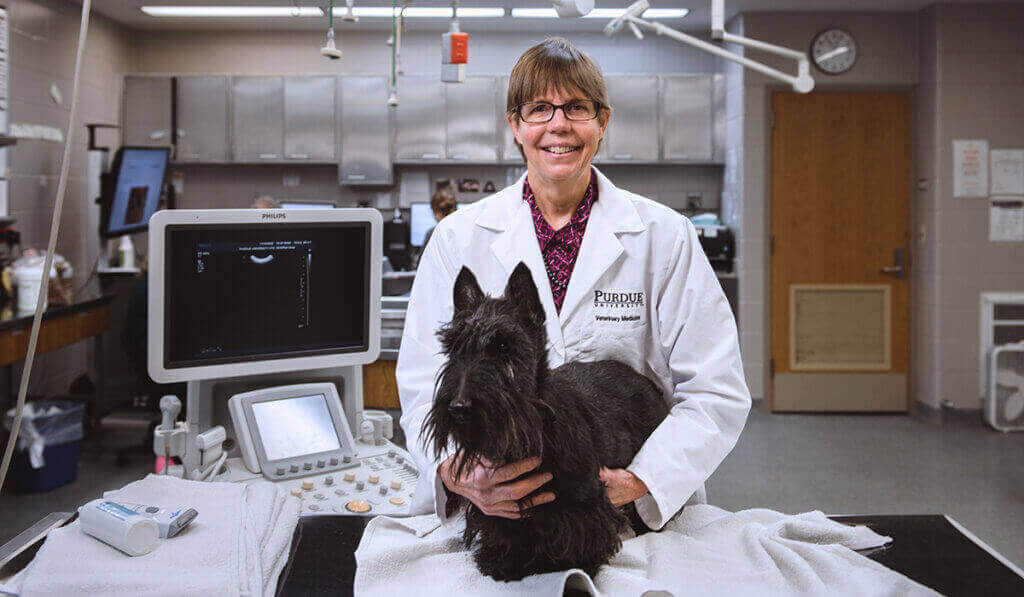
The tools created at Purdue could be adapted across the animal kingdom, with insights in one species feeding discovery in the others and accelerating knowledge and therapeutics. The project draws on the expertise of six Purdue faculty members, including Deborah Knapp, DVM, MS, DACVIM-Oncology, a canine cancer scientist and the Dolores L. McCall Professor of Comparative Oncology in the College of Veterinary Medicine, who leads a long-running study of dogs with bladder cancer including Scottish terriers, a breed that develops bladder cancer at a rate 20 times higher than other dog breeds.
“Where before we could look at maybe three types of data at a time, my expectation is that we’re going to be able to feed many, many data types into this model and use it to simulate scenarios across all those data types,” Dr. Knapp said. “It’s likely that we’re going to be able to answer clinical questions that we can’t yet answer.”
Lanman said the project will likely build two comprehensive models — one focused on canine data and one on human data — which will be used to help inform each other. As its name suggests, a digital twin model uses data and computing techniques to create a virtual representation of its real-world counterpart for the purposes of experimentation and simulation. The team is beginning its work by using the canine model to ask questions about canine metastasis — spread of cancer cells from the original tumor — of bladder cancer.
“Metastasis is hard to study and there’s not a lot known about how it occurs and the similarities between the primary tumor and the metastasis, so there’s a lot of basic biology to figure out,” Lanman said. “The canine data gives us the opportunity to look at metastasis in a way that we can’t in humans because we don’t have access to metastatic tumor samples, which are not generally surgically removed from human patients. The canine data will help us know what features to look at in the human data.”
The digital twin model combines machine learning techniques with Dr. Knapp’s veterinary data, human health records, an image classification system the project is developing and new molecular data being commissioned for the project.
“Leveraging Cross-species Digital Twins for Modeling Cancer Progression and Outcome” is one of four research projects awarded seed grant funding through a university-wide life and health sciences summit held in November 2023. The research, which studies and would benefit both animals and humans, is part of Purdue’s One Health initiative, a presidential initiative that involves research at the union of humans, animals and plants.
“What is happening to both dogs and humans that leads to bladder cancer? Is it aging, genetics, something in the environment? Our shared experience with our pets makes this a compelling space to explore,” said Kaethe Beck, Purdue assistant vice president for strategic impact in life and health sciences. “And while this project focuses on bladder cancer in dogs and humans, the algorithms that the researchers will develop aren’t unique to dogs or humans; they will have application across species and diseases.”
In diseases where similarities exist between dogs and humans, modeling across species can be helpful for several reasons, Lanman said. Dogs receive veterinary care, and the data collected in their treatment is less restricted than human health records. And after the dog has died, owners will often allow researchers to collect tissue samples from the primary tumor as well as metastatic tumors, an option that is rarely possible with humans.
Dr. Knapp said many known similarities between invasive bladder cancer in Scottish terriers and humans make the cross-species comparison ideal. In both species, some of the same genes are involved in the disease — and they share mutations that lead to cancer. In both dogs and humans, the cancers appear similar under a microscope and metastasize to similar locations in the body at a similar rate. At the molecular level, the cancer can be divided into two major molecular subtypes that affect how the cancer will behave.
Dr. Knapp’s research on Scottish terriers has already paid dividends in understanding human bladder cancer. Her team’s most recent work found an environmental factor — exposure to cigarette smoke — that increases cancer risk in dogs, and has led to new techniques for early detection and treatment of cancer. The new model may yield additional insights in areas like environmental or genetic factors, early signs and symptoms, immune response, drug response and metastasis.
To help inform the model, the team is using AI tools to analyze images of tumor cells. In the first step, researchers manually label about 50 cells in a tumor image that display recognizable characteristics of cancer, such as abnormal shape or an overly large nucleus. The image, with labeled cells, is fed into an AI program that “learns” to make an accurate prediction about the characteristics of unlabeled cells. Then the computer labels the remaining cells in the image, processing an entire image of thousands of cells quickly and improving the accuracy of the algorithm with each attempt.
The labeled images, separated into different categories — such as those that responded well to treatment, those that metastasized or those from patients with a similar health history — will be introduced to additional AI tools that extract the features associated with those cancer types. When incorporated into the larger digital twins model, with its wide breadth of data types, this information will aid in predicting the course of newly diagnosed cancers.
The model’s predictions can also be used to inform additional preclinical models, using that information to develop therapies to address those aspects of the disease.
“Why does bladder cancer spread throughout the body in one person, or one dog, and why does it stay confined to the urinary system for months to years in another individual? Everything we’ve learned so far can give you information about groups — like what subtype the cancer is — but we can’t say ‘this individual will have metastasis,’” Dr. Knapp said. “The digital twin model may lead to our ability to predict what will happen in the individual. And that will be really powerful.”
In addition to Knapp and Lanman, both of whom are members of the Purdue Institute for Cancer Research, the research team includes Vaneet Aggarwal, a professor in the Edwardson School of Industrial Engineering in the College of Engineering; Ananth Grama, Samuel D. Conte Distinguished Professor of Computer Science in the College of Science; Seung-Oe Lim, an associate professor in the Borch Department of Medicinal Chemistry and Molecular Pharmacology in the College of Pharmacy; and Mario Sola, clinical assistant professor in the College of Veterinary Medicine’s Department of Comparative Pathobiology.
