
Experts in tumor ablation devices join Purdue Veterinary Medicine’s comparative oncology team
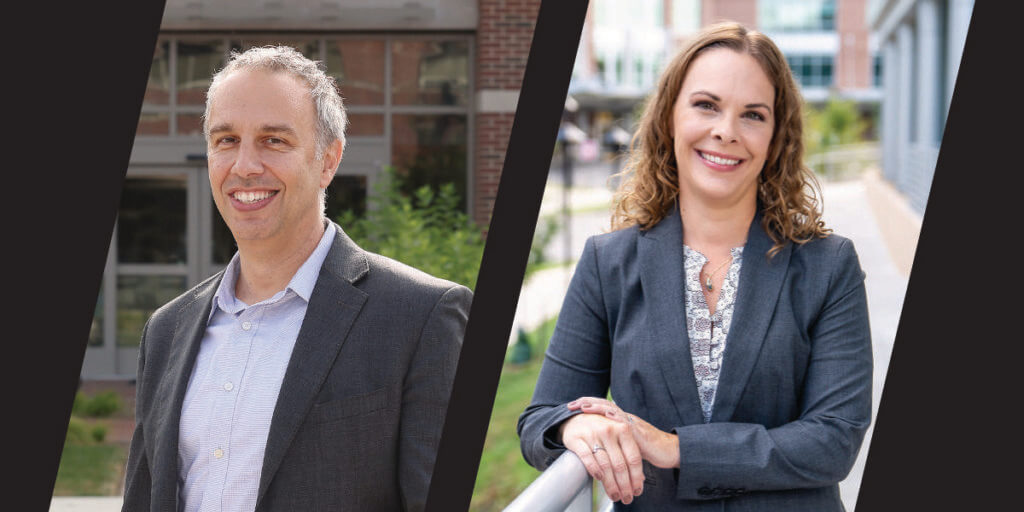
A husband-wife team of veterinary oncologists with expertise in tumor ablation devices is now part of the Purdue University College of Veterinary Medicine’s Department of Veterinary Clinical Sciences and the Evan and Sue Ann Werling Comparative Oncology Research Center. Dr. Nick Dervisis and Dr. Shawna Klahn started in their new roles as Purdue associate professors of comparative oncology August 12 as part of the university’s Moveable Dream Hires program.
Dr. Dervisis and Dr. Klahn came to Purdue from the Virginia-Maryland College of Veterinary Medicine at Virginia Tech University where they jointly established the medical oncology research and clinical services program. When the couple was recruited to Virginia Tech in 2012, they shared a vision of creating the nation’s premier cancer research hospital.
“We are passionate about translational medicine — moving basic science from the bench to the bedside,” Dr. Dervisis said. “We did everything in parallel, but the research was our unifying force. Holding clinical trials expanded our clinical services while also contributing to the research. The teaching and training of veterinary students revolved around the research. Everything centered around our research enterprise.”
Initially, Dr. Klahn focused on building the clinical services and student education aspects while Dr. Dervisis established the foundation for the translational research. Dr. Klahn remained involved in clinical research, procuring her own grant funding, and moved into a tenure track position with more research focus at the first opportunity.
During 12 years at Virginia Tech, Dr. Dervisis and Dr. Klahn grew the medical oncology program from their two positions to a team of seven veterinary oncologists and established themselves as leading experts in the development of tumor ablation devices for veterinary oncology. Generally, tumor ablation involves using extreme heat or cold to destroy cancerous cells. Dr. Dervisis and Dr. Klahn also are testing the use of high-intensity focused ultrasound (HIFU), essentially tightly focused sound waves, to heat or disintegrate tumors.
“We work with devices that deliver energy to a tissue,” Dr. Dervisis says. “That energy can be delivered either invasively or non-invasively. Many of these technologies have been around for decades but are used primarily in a lab setting. At Purdue, we want to develop devices that allow for the use of these procedures in a clinical setting.”
The talent-based Moveable Dream Hires program is piloted by the deans and provost to attract high-performing, top-caliber faculty to Purdue even when the topic-based openings in a given year do not match the moveable talent. It complements typical topic-based faculty searches across the university and enables the recruitment of faculty who may not be actively on the job market. These recruits are tenure-track or tenured faculty.
Dr. Dervisis and Dr. Klahn hold joint appointments in the College of Veterinary Medicine and the Purdue Institute for Cancer Research. They join Dr. Marejka Shaevitz, clinical assistant professor of oncology, in doubling the number of medical oncology faculty in the Department Veterinary Clinical Sciences. The addition of three new faculty positions was made possible, in part, by a transformative $10 million gift to establish the Evan and Sue Ann Werling Comparative Oncology Research Center last year.
Through the Purdue Institute for Cancer Research, Dr. Dervisis and Dr. Klahn will contribute to a transdisciplinary environment that unites Purdue’s diverse research strengths from across the university in order to advance cutting-edge cancer solutions.
“Dr. Dervisis and Dr. Klahn have a dedication to conducting high quality comparative research that extends the lives of companion animals but also translates to improving human health,” said Dr. Deborah Knapp, Distinguished Professor of Comparative Oncology, the Dolores L. McCall Professor of Comparative Oncology and director of the Werling Comparative Oncology Research Center. “The addition of their expertise in ablative technology will allow us to expand our scope of research and test more discoveries originating through the Institute for Cancer Research.”
The interdisciplinary nature of tumor ablation requires engineers, surgeons, radiologists, anesthesiologists and pathologists to develop and complete procedures. Dr. Dervisis and Dr. Klahn plan to partner with colleagues in the College of Engineering to further develop their biomedical technology and translate laboratory discoveries into tangible patient outcomes.
“We cannot function unless we have everybody on the team,” Dr. Dervisis said. “Cancer is a complex disease. You need many people from different backgrounds and specialties to solve a complex problem.”
Originally from Greece, Dr. Dervisis earned his Doctor of Veterinary Medicine degree from the School of Veterinary Medicine at Aristotle University in Thessaloniki, Greece. After completing his veterinary studies, he served in the Hellenic Army before earning a PhD in comparative medicine and integrative biology and completing a residency in veterinary medical oncology, both at Michigan State University.
Dr. Klahn hails from the Midwest and earned her Bachelor of Science in zoology as well as her Doctor of Veterinary Medicine degree from the University of Wisconsin-Madison. She completed her residency in medical oncology at Michigan State. She was the first faculty member from the VA-MD College of Veterinary Medicine to become a Clinical and Translational Science Award (CTSA) scholar through the integrated Translational Health Research Institute (iTHRIV) of Virginia. The highly competitive CTSA program is administered by the National Institutes of Health (NIH) with an outcome measure of securing significant federal funding.
“It can be difficult to get significant funding for research in veterinary medicine, even when you study a disease that overlaps with human diseases,” Dr. Klahn said. “We just don’t have access to the same resources as researchers in human medicine. I was the first DVM in the CTSA scholar program, the first person from the veterinary college to even try to do this. My journey was being watched. There was a lot of pressure for me to succeed in getting funding.”
Dr. Klahn received her first NIH grant in February for $600,000. The grant will support her research into the treatment of soft tissue sarcomas with a mechanical form of HIFU (also known as histotripsy). In both dogs and humans diagnosed with soft tissue sarcoma, the current first line of treatment is surgery. But these tumors often have tiny tendrils of cancer that extend out into surrounding tissue so large areas must be resected to excise all cancerous tissue from the body. Even with wide resection, the local recurrence rate can be as high as 36%.
“We really need an alternative to surgery for treating soft tissue sarcoma,” Dr. Klahn said. “We have some technology now that we can use to treat part of the tumor, but we can’t treat the entire tumor. Being able to treat the entire tumor is an important obstacle to overcome on the road toward moving this technology into human health care.”
The biggest hurdle is time. It takes too long to fully ablate a large soft tissue sarcoma and the risks of anesthesia tend to be greater the longer a patient is anaesthetized. Dr. Klahn hopes to develop a methodology that will treat each focus point faster, speeding up the ablation process and enabling full destruction of the entire tumor. Dr. Klahn plans to begin enrolling dogs into a first-phase clinical trial in 2025. As she develops and tests this device, she will be collaborating with Dr. Dervisis, just as they have for the past 20-plus years.
“People sometimes ask me, ‘How can you work with your husband? I could never do that,’” Dr, Klahn says. “I love working with Nick. We trained under the same program and share the same goal of advancing translational medicine. Our strengths and skills are so complementary. We’ve always made a great team and joining the team of legendary translational oncology researchers at Purdue together is really exciting.”
Dr. Dervisis echoed the sentiment, adding “It’s wonderful to come to a place that grows and values creativity because the evolution of our work has been very creative.”
