
PVM Study Shows Service Dogs Associated with Lower PTSD Symptoms among War Veterans

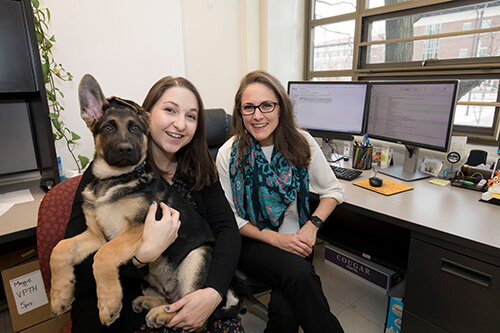
Dr. Maggie O'Haire, PVM assistant professor of human-animal interaction, with Kerri Rodriguez, human-animal interaction graduate student in PVM’s Department of Comparative Pathobiology, and her dog Hendrix.

Dr. Maggie O’Haire, PVM assistant professor of human-animal interaction, with Kerri Rodriguez, human-animal interaction graduate student in PVM’s Department of Comparative Pathobiology, and her dog Hendrix.

By Megan Huckaby, Purdue News Service and Kevin Doerr

A preliminary study led by researchers in the Purdue University College of Veterinary Medicine has shown that overall symptoms of post-traumatic stress disorder (PTSD) are lower among war veterans with service dogs. The pilot study was co-funded by the Human Animal Bond Research Institute (HABRI) and Bayer Animal Health.

The study was led by Assistant Professor of Human-Animal Interaction Maggie O’Haire, in the Department of Comparative Pathobiology, with the help of K9s For Warriors, an accredited nonprofit organization that provides veterans with service dogs. The pilot research project gives scientific evidence of mental health benefits experienced by veterans with PTSD who have service dogs.

“We found that the group of veterans with service dogs had significantly lower levels of PTSD symptomology than those who did not have a service dog,” Dr. O’Haire says. “They also had lower levels of depression, lower anxiety, and increased social participation, meaning a willingness to leave their house and go engage with society in different activities.” The study is published in the February issue of the Journal of Consulting and Clinical Psychology.

Participants were recruited between November 2015 and February 2016 from a national sample of 304 individuals who applied and were approved to receive a trained PTSD service dog from K9s For Warriors. Of these, 141 individuals chose to participate in the preliminary trial. Approximately half of the sample of participants were on the waitlist to receive a service dog and the other half already had a service dog.

Measurements of various aspects of PTSD symptoms, quality of life, social functioning, and work were analyzed and compared between the two groups. Results reveal that veterans suffering from PTSD exhibited better mental health and well-being on several measures if they had a service dog, including:

  • Lower overall symptoms of post-traumatic stress
  • Lower levels of depression
  • Higher levels of life satisfaction
  • Higher overall psychological well-being
  • Lower levels of social isolation and greater ability to participate in social activities
  • Higher levels of resilience
  • Higher levels of companionship
  • Less absenteeism from work due to health among those who were employed

The only areas measured in which there was no significant difference between the two groups were physical functioning and employment status.

“This innovative study applied rigorous research methodology to an area that has historically been characterized by a reliance on anecdotal accounts and intuition rather than evidence-based science,” Dr. O’Haire says. Click here to view a video of Dr. O’Haire explaining the study.

Dr. Maggie O'Haire reviews research information with study co-author Kerri Rodriguez, who is part of the Organization for Human-Animal Interaction Research and Education (OHAIRE) research group at Purdue University.

Kerri Rodriguez, human-animal interaction graduate student in the Department of Comparative Pathobiology, was co-author of the study. Kerri is part of the Purdue University research group led by Dr. O’Haire, called the Organization for Human-Animal Interaction Research and Education (OHAIRE).

“The results have important implications for understanding the specific areas of life that a PTSD service dog may help improve,” says Kerri. “As the number of service dogs given to veterans with PTSD continues to increase, this is an important first step towards proof of concept that service dogs can actually provide measurable, clinical changes for veterans.” Dr. O’Haire and Kerri also say that service dogs did not replace evidence-based treatment for PTSD, nor did they cure it. While the veterans still had PTSD, they had significantly lower levels of symptoms.

“Pairing service dogs with our nation’s veterans should be recognized as a significant complementary method of treatment,” says HABRI Executive Director Steven Feldman. “The U.S. Department of Veterans Affairs has cited a lack of scientific research supporting service dogs for veterans with PTSD. This study is a significant step in providing scientific documentation, and I hope the promising results from this study will prompt a renewed focus on the benefits that service dogs provide.”

Bayer Animal Health Vice President for Companion Animal Product Marketing David Van Brunt says the lifetime bonds that these service dogs form with their veterans are built on mutual love, care, and devotion. “The results of this study demonstrate not only the impact of this unbreakable bond, but that these service dogs are so much more than service dogs; they are able to bring the joy of living back into veterans’ lives. Bayer is committed to ensuring that these service dogs receive the proper and routine care they need to support their veteran on a daily basis,” David says.

The research team will now move on to a National Institutes of Health-funded research project in which veterans with and without service dogs will be studied for an extended period of time. Dr. O’Haire says the valuable data from the pilot study helped secure the NIH R21 grant to conduct the large-scale, clinical trial to further investigate the efficacy and role of service dogs for military veterans with PTSD and their spouses.

Recent Stories

“Paws Up” – brought to you by the PVM Wellness Committee

This week our gratitude goes to Andrea Kellogg, who is the director of Lifelong Learning.

Purdue Veterinary Students Get Up Close View of Veterinary Care at Professional Bull Riding Event

During a weekend dedicated to championship-level competition, students from the Purdue University College of Veterinary Medicine gained a first-hand perspective on a unique aspect of the livestock industry with a behind-the-scenes pass to the Professional Bull Riding event held recently in Indianapolis.  Ram Trucks PBR Indianapolis presented by Cooper Tires was held at Gainbridge Fieldhouse March 21-22, even as first- and second-round NCAA Men’s Basketball Tournament games were held across the country the same weekend.

In Memory – Professor Emeritus of Veterinary Physiology Gerald Bottoms

The Purdue Veterinary Medicine community is deeply saddened to learn that Dr. Gerald D. Bottoms, a longtime faculty member and Professor Emeritus of Veterinary Physiology, passed away on February 24, 2026.  He was 95.

PVM Scholars Recognized at Purdue One Health and Well-Being Research Event

Purdue University’s recent One Health and Well-Being Research Event: A Celebration of Interdisciplinary Health Research, put the spotlight on several scholars in the College of Veterinary Medicine.  The one-day event was organized by the College of Health and Human Sciences in partnership with several other colleges including Purdue Veterinary Medicine. It is estimated that more than 300 people attended the event at the Purdue Memorial Union North and South Ballrooms March 10.

In Memory – Dr. Jeffrey Hanssen (PU DVM ’71)

The College of Veterinary Medicine mourns the passing of an alumnus and longtime practitioner from Greenfield, Indiana. Dr. Jeffrey Hanssen died March 12, 2026, at Brandywine - Brickyard Healthcare Center in Greenfield. He was 71.

Beautiful Spring Lilies Pose Serious Danger to Cats

Spring weather heralds the arrival of the beautiful blooms of true lilies (Lilium sp.) and daylilies (Hemerocallis sp.). Unfortunately, many cats have been poisoned by these lovely plants. The poisoning is so severe and the possible consequences so dire (even death) that in 2021, the FDA issued this warning: “Lilies in the “true lily” and “daylily” families are very dangerous for cats. The entire lily plant is toxic: the stem, leaves, flowers, pollen, and even the water in a vase. Eating just a small amount of a leaf or flower petal, licking a few pollen grains off its fur while grooming, or drinking the water from the vase can cause your cat to develop fatal kidney failure in less than 3 days. The toxin, which only affects cats, has not been identified. Dogs that eat lilies may have minor stomach upset but they don’t develop kidney failure.”

Through study abroad opportunities, Purdue’s Veterinary Technology Distance Learning program is helping students think globally

Promoting animal health is a value that transcends cultures and unites the world. That’s why there are veterinary professionals practicing in nearly every country around the globe. But access to high-quality, affordable veterinary care is far from universal — in many nations, particularly developing nations, access to veterinarians is inconsistent, and affordability is a concern all over the world. To confidently address these issues, veterinary professionals must be able to think globally. That’s why Purdue Veterinary Medicine encourages students to study abroad, including those in the Veterinary Technology Distance Learning Program (VTDL). “Study abroad enriches our online curriculum by bringing classroom concepts to life in a global, real-world context,” said Addison Sheldon, the college’s director of global engagement. The VTDL program offers students the option to study abroad in Guatemala, Japan and Zimbabwe by partnering with local universities and organizations.

Public Invited to Learn about Veterinary Medicine at 2026 PVM Open House April 18

The Purdue University College of Veterinary Medicine will welcome the public for its annual Spring Open House at Lynn Hall on Saturday, April 18, 2026. Scheduled from 9:00 a.m. to 4:00 p.m., the event will feature a hands-on look at the world of veterinary medicine.

Annual Purdue Veterinary Technician Symposium Remains Popular in 12th Year

The enduring popularity of the annual Purdue Veterinary Technician Symposium was evident again this spring as more than 125 participants turned out for the day-long continuing education program in Lynn Hall. The 12th annual symposium on Sunday, March 8, attracted attendees from Indiana and seven other states, including Illinois, Michigan, Wisconsin, South Carolina, Pennsylvania, Alabama and Ohio.

Ruby’s Road to Recovery

When Ruby first came to the Purdue University Veterinary Hospital, she was just nine months old, and her injuries were more complex than when they first appeared. Ruby is a toy poodle and over a month earlier, while playing, she jumped off a couch and fractured both of her front legs. Despite several weeks of treatment with splints and casts, her legs were not healing properly. She had surgery performed on both her front legs and received a bone graft to help speed up the healing process. With meticulous surgical aftercare and a planned series of rechecks, Ruby began her journey to recovery.