
Purdue Veterinary Ophthalmologist Contributes to Purdue-led Research to Develop Tech to Monitor, Treat Chronic Eye Diseases

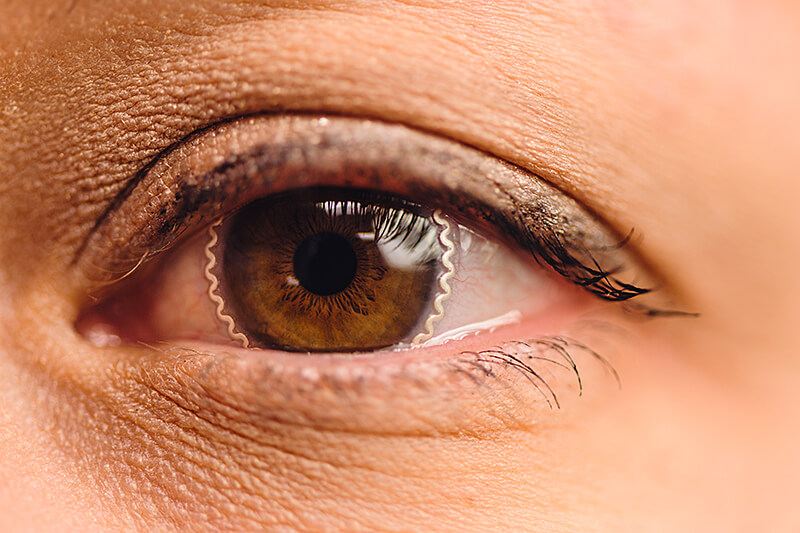
Close-up view of a human eye with a detailed and clear view of the iris and pupil, surrounded by natural eyelashes, symbolizing the focus on ocular health in innovative contact lens research.
A team of researchers from Purdue University, Indiana University School of Optometry and Michigan Medicine has received two grants totaling $6.7 million from the National Eye Institute to further develop specialized smart soft contact lenses that continuously monitor or treat chronic eye diseases. (Purdue University photo/Rebecca McElhoe)

Research teams led by a faculty member in Purdue University’s College of Engineering will use two grants from the National Eye Institute totaling $6.7 million to further develop specialized smart soft contact lenses that continuously monitor or treat chronic ocular diseases like glaucoma, corneal neovascularization and dry eye syndromes.  The research teams include Dr. Shin Ae Park, assistant professor of ophthalmology in the Purdue University College of Veterinary Medicine.

The teams are led by Dr. Chi Hwan Lee, the Leslie A. Geddes Associate Professor of Biomedical Engineering in Purdue’s Weldon School of Biomedical Engineering. He holds a joint appointment in the School of Mechanical Engineering and a courtesy appointment in the School of Materials Engineering.  The research teams are developing patent-pending lenses, which can painlessly deliver therapeutic drugs or accurately measure intraocular pressure, or IOP. IOP is the only known modifiable risk factor for glaucoma.

In addition to Dr. Park, other researchers involved on the teams are Dr. Bryan Boudouris, Purdue’s associate vice president for research in strategic interdisciplinary research and the R. Norris and Eleanor Shreve Professor of Chemical Engineering in the Davidson School of Chemical Engineering; Dr. Pete Kollbaum, associate dean for research, director of the Borish Center for Ophthalmic Research and professor in Indiana University’s School of Optometry; and Dr. Yannis Paulus, associate professor of ophthalmology and visual sciences and biomedical engineering at Michigan Medicine.

Additional team members also included Dr. Jinyuan Zhang, a former Purdue postdoctoral student in biomedical engineering and now a health technologies research and development engineer at Apple, and Yumin Dai, a graduate student in the School of Materials Engineering.

“Working on smart soft contact lenses allowed us to engage in top-tier interdisciplinary research, moving beyond theory to craft real-world solutions that aim to transform eye disease treatment,” Dai said.

The National Eye Institute is one of the National Institutes of Health; the funding comes from the NIH Research Project Grant Program, or R01.

The innovation

Dr. Lee specializes in StickTronics, which are stickerlike items that contain electronics or smart technology. He develops wearable biomedical devices that continuously monitor and manage chronic diseases or health conditions unobtrusively.

Some traditional wearable tonometers — devices that measure pressure inside the eyes — are equipped with an integrated circuit chip. This increases contact lens thickness and stiffness compared with a typical commercial soft contact lens, in many cases causing discomfort for patients. The research team’s version is different.

“To address this unmet need, we developed a unique class of smart soft contact lenses built upon various commercial brands of soft contact lenses for continuous 24-hour IOP monitoring and potentially treatment, even during sleep at home,” Dr. Lee said. “Our smart soft contact lenses retain the intrinsic lens features of lens power, biocompatibility, softness, transparency, wettability, oxygen transmissibility and overnight wearability. Having all these features at the same time is crucial to the success of translating the smart soft contact lenses into ocular disease care, but these features are lacking in current devices.”

The NEI grants

Dr. Lee said the $6.7 million funding from the two NEI grants will further refine the smart soft contact lenses. Concurrently, clinical trials will be conducted in collaboration with Purdue’s College of Veterinary Medicine, the IU School of Optometry and Michigan Medicine to assess the lenses’ biosafety, usability, functionality, therapeutic effectiveness and durability.

“With the steadfast support from NEI, the successful completion of these projects will solidify our path toward introducing an innovative, closed-loop system for these smart contact lenses,” Dr. Lee said. “This system will enable simultaneous monitoring and drug delivery for a wide range of chronic ocular diseases.” Dr. Lee disclosed the smart soft contact lenses innovation to the Purdue Innovates Office of Technology Commercialization, which has applied for a patent from the U.S. Patent and Trademark Office to protect the intellectual property.

Writer(s): Steve Martin | pvmnews@purdue.edu

Recent Stories

Fourth Purdue AMR Conference Promotes Collaboration to Address Global Health Threat of Antimicrobial Resistance through PVM’s One Health Initiative. 

Purdue University served as the place where local, national and international experts came together in-person and online recently for concentrated sharing of research, expertise and insight targeting the threat of multi-drug-resistant infections. The fourth annual AMR Conference February 25-26, 2026, held in Stewart Center, attracted more than 100 attendees from across the U.S. and six other countries.

Presentation of Research Poster Prizes Wraps up Antimicrobial Resistance Conference 

Purdue University’s fourth Antimicrobial Resistance Conference concluded February 26 with remarks from Purdue Vice President for Health Affairs and Jeannie and Jim Chaney Dean of Pharmacy Eric Barker, PhD, who also announced the winners of the conference’s research poster session.  The poster contest, which attracted more than 20 entries, was divided into categories for undergraduate and graduate students.

“Paws Up” – brought to you by the PVM Wellness Committee

Today we are glad to highlight one of our own committee members. Charlene Evans, Toxicology Laboratory Supervisor in the Reed Animal Disease and Diagnostic Laboratory, is a wonderful champion for mental health and wellbeing on the PVM Wellness Committee and within the ADDL community.

Purdue Professor of Large Animal Surgery Named Veterinary Clinical Sciences Department Head

Dr. Timothy Lescun, a board-certified large animal surgeon, has been appointed head of the Department of Veterinary Clinical Sciences in the Purdue university College of Veterinary Medicine.

Purdue Veterinary Medicine Engages with Swine Health Leaders at AASV

The Purdue University College of Veterinary Medicine was well-represented at the 2026 American Association of Swine Veterinarians (AASV) Annual Meeting, which provided important continuing education and networking opportunities for swine practitioners. The conference in Las Vegas February 28 through March 3, 2026, also provided the opportunity for the college to engage with alumni and partners who are influencing the future of animal agriculture.

Boilers, Ballgowns, Boilermaker Pride and PVM!

With a fun twist on classic title, the 2026 Purdue Boilermaker Ball provided a meaningful evening of celebrating Purdue University’s distinguished heritage and traditions, and the Purdue University College of Veterinary Medicine was proud to be part of the event. Dubbed “A Midwinter Night’s Dream,” the festive function February 28 at the Indianapolis Marriott Downtown proved to be one enchanted evening! PVM alumni and donors were among the guests for the creative black-tie event, and enjoyed the opportunity to visit and share the common commitment to veterinary medicine, animal health, and the mission of the College of Veterinary Medicine.

Purdue Alumni Honored with IVMA Awards for Achievement, Volunteer Service and Contributions to Profession

The Indiana Veterinary Medical Association (IVMA) recognized several Purdue Veterinary Medicine alumni with awards and honors at the association’s 2026 Crossroads Veterinary Conference.  The annual meeting in Noblesville, Indiana, was held February 5-7 and featured scientific and practice management sessions for veterinary professionals as well as an exhibit hall. As part of the conference, the IVMA hosted its membership meeting February 5, when awards and honors were presented.

Keeping Your Pets Safe from Highly Pathogenic Avian Influenza (HPAI)

The Purdue Veterinary Hospital has not detected Highly Pathogenic Avian Influenza (HPAI) in its practices but is providing important information to help pet and livestock owners stay informed. HPAI affects various species, including birds, cats, dogs, and livestock, and can spread through contact with infected animals or raw food. To reduce risk, avoid feeding raw meat or unpasteurized dairy to pets, limit wildlife exposure, and use protective gear when handling animals. Owners of feline and avian patients will be asked screening questions during appointments.

Purdue Engineering Hosts PVM Canine Educators for ‘Canines, Cookies, and Calm’ During Mental Health Action Week

Purdue Veterinary Medicine’s beloved Canine Educators found themselves amidst a throng of engineering students last Friday, March 7, in the Herman & Heddy Kurz Atrum of Armstrong Hall, where they were the center of attention during an event on the final day of Purdue’s Mental Health Action Week (MHAW). Named “Canines, Cookies, and Calm,” the event hosted by the College of Engineering fostered smiles, laughter, and endless thanks from a total of some 300 engineering students.

“Paws Up” – brought to you by the PVM Wellness Committee

March is National Social Work Month! It’s a perfect time to recognize our very own Veterinary Hospital Social Worker, Jennifer Dehn, LSW, MSW.