
Dr. Willie M. Reed, dean of the Purdue University College of Veterinary Medicine, is the recipient of the American Veterinary Medical Association’s inaugural Frederick Douglass Patterson Lifetime Achievement Award for his distinguished leadership in promoting diversity, equity, and inclusion (DEI) in the veterinary profession.
Dean Reed’s selection was made by the AVMA Board of Directors and the award was presented Friday, July 14 at the organization’s annual convention in Denver, Colorado.
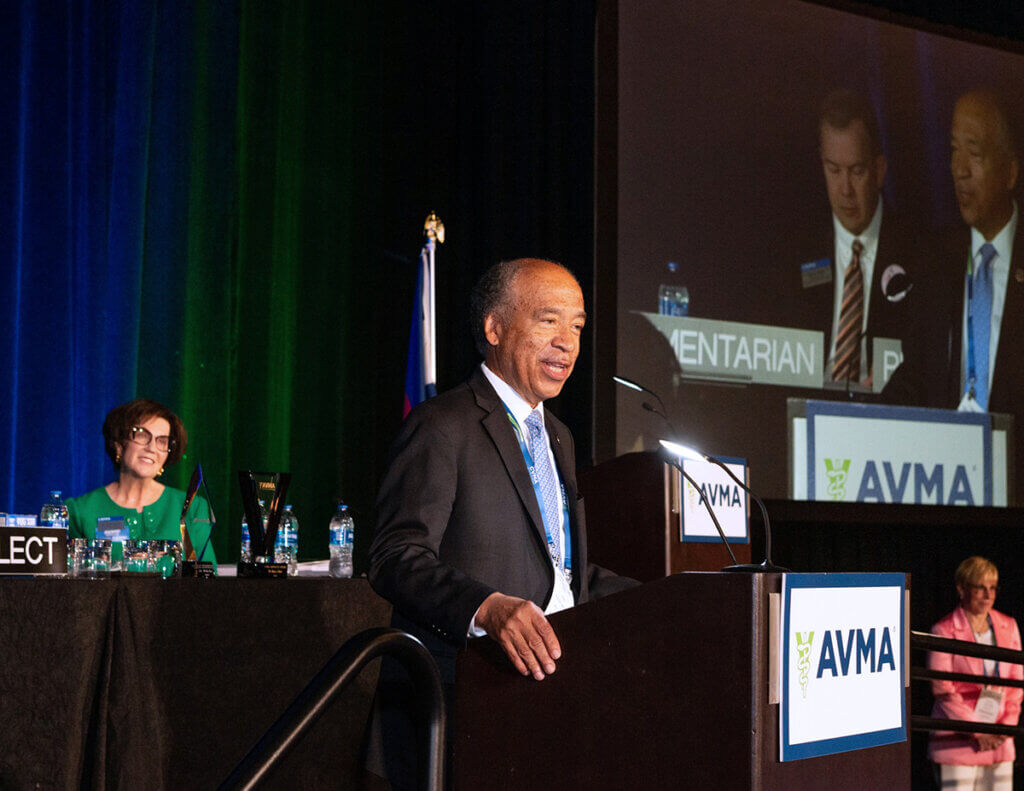
The award’s namesake and Dean Reed both are notable figures in the field of veterinary medicine who share similarities. They are Black veterinarians who hail from the South and have lived out a commitment to fostering opportunities for underrepresented groups within the veterinary profession. Both Drs. Patterson and Reed also had a connection with Tuskegee University during their formative years, albeit through different avenues.
In 1945, Dr. Patterson helped establish what is now known as the Tuskegee University College of Veterinary Medicine, as the university’s president at the time. Dr. Reed earned his veterinary degree at Tuskegee 33 years later and embarked on a career that led to the veterinary deanship at Purdue, where he has promoted an inclusive culture and created opportunities for underrepresented individuals not only at the veterinary college, but also in the profession as a whole.
“Much like Dr. Frederick Douglass Patterson, your steadfast commitment has allowed you to bring about meaningful change and establish a strong foundation for DEI at Purdue University and in the profession,” Dr. Janet Donlin, the AVMA’s Executive Vice President and CEO, wrote to Dean Reed when she informed him of his selection as the inaugural award recipient. “Your innovative mindset and visionary leadership have propelled veterinary medicine forward in the realm of DEI.”
When the AVMA announced the establishment of the new honor and invited nominations last April, AVMA President Dr. Lori Teller noted, “We want to recognize member veterinarians who have made significant contributions to the veterinary profession through advancing DEI. There is no better way to do this than by bestowing an annual award named after Dr. Patterson, who was such a visionary leader.”
Dean Reed grew up in a rural part of southern Alabama and experienced first-hand the transition from segregation to the post-integration era in the 1960s and 1970s. He received his bachelor’s degree in animal and poultry science with high honors from Tuskegee University, a historically Black college and university (HBCU) formerly known as Tuskegee Institute, and went on to earn his Doctor of Veterinary Medicine degree at Tuskegee in 1978.
Dean Reed made his first trip to Purdue to pursue a PhD in veterinary pathology, which he earned in 1982. He stayed, teaching veterinary pathology as an associate professor and then becoming assistant director of the Animal Disease Diagnostic Laboratory. In 1990, he left to accept a position at Michigan State University College of Veterinary Medicine where he became a full professor of veterinary pathology and director of the Diagnostic Center for Population and Animal Health (DCPAH), which is now called the Veterinary Diagnostic Laboratory. In 1997, he also was appointed as chairperson of the Department of Pathobiology and Diagnostic Investigation at MSU.
In 2007, he returned to Purdue as dean of the College of Veterinary Medicine. Among Dean Reed’s many achievements at Purdue, he modernized teaching, clinical, and research facilities; expanded the class size by 20 percent; and significantly increased the diversity of the student body, while recruiting outstanding faculty in a wide range of disciplines from around the globe.
In the 2006-07 school year, underrepresented minority (URM) students accounted for 5.4% enrollment across all four years of Purdue’s veterinary program. Today, because of intentional recruitment and retention efforts, Purdue has 29.2% URM enrollment across all four years, and 205 URM veterinary students have graduated from 2008-23.
Those efforts, developed under Dean Reed’s leadership, include:
- Being awarded $136,000 in 2008 by the U.S. Department of Agriculture (USDA) National Institute of Food and Agriculture (NIFA) to create the Multicultural Scholars Program (MSP) to support recruitment and retention of URM veterinary students.
- Receiving a five-year, $3.18 million award in 2018 from the Department of Health and Human Services’ Health Resources and Services Administration to support the Vet Up! National Health Careers Opportunity Program Academy for Veterinary Medicine. The program’s goal is to fill veterinary shortage areas with individuals from underrepresented populations and rural areas.
- Leading a collaborative effort resulting in the publication of the first book on diversity and inclusion in veterinary medicine, “Navigating Diversity and Inclusion in Veterinary Medicine,” in 2013.
- Establishing a partnership in 2014 among Purdue, the AVMA, and the American Association of Veterinary Medical Colleges (AAVMC) to establish the first Center for Diversity and Inclusion in Veterinary Medicine, which offers online certificate programs in diversity and inclusion for veterinarians, veterinary technicians and veterinary nurses, educators, and veterinary students.
- Growing Purdue’s Science Education Partnership Award (SEPA) program of the National Institute of General Medical Sciences (NIGMS) of the National Institutes of Health (NIH), to engage under-resourced children in veterinary medicine. Purdue leads teams of veterinary role models in the League of VetaHumanz program across the country who partner with community organizations and schools to support under-resourced elementary school children through mentoring and delivering veterinary lessons.
Throughout Dean Reed’s tenure as dean, the college has developed and been guided by a series of strategic plans. Drs. Sandra San Miguel, associate dean for engagement, and S. Kathleen Salisbury, associate dean for academic affairs at the college, both nominated Dean Reed. They wrote: “Strategic plans don’t get dusty at Purdue. We are currently on our third strategic plan, led by Dr. Reed, each affirming the college’s values, culture, and commitment to promote a collegial, diverse and supportive work and learning environment enhanced by diversity of gender, race, ethnicity, sexual orientation, career goals, socioeconomic background, educational background, and geographic background. The college’s strategic plan is further bolstered by a strategic plan specifically focused on diversity, equity, and inclusion.”
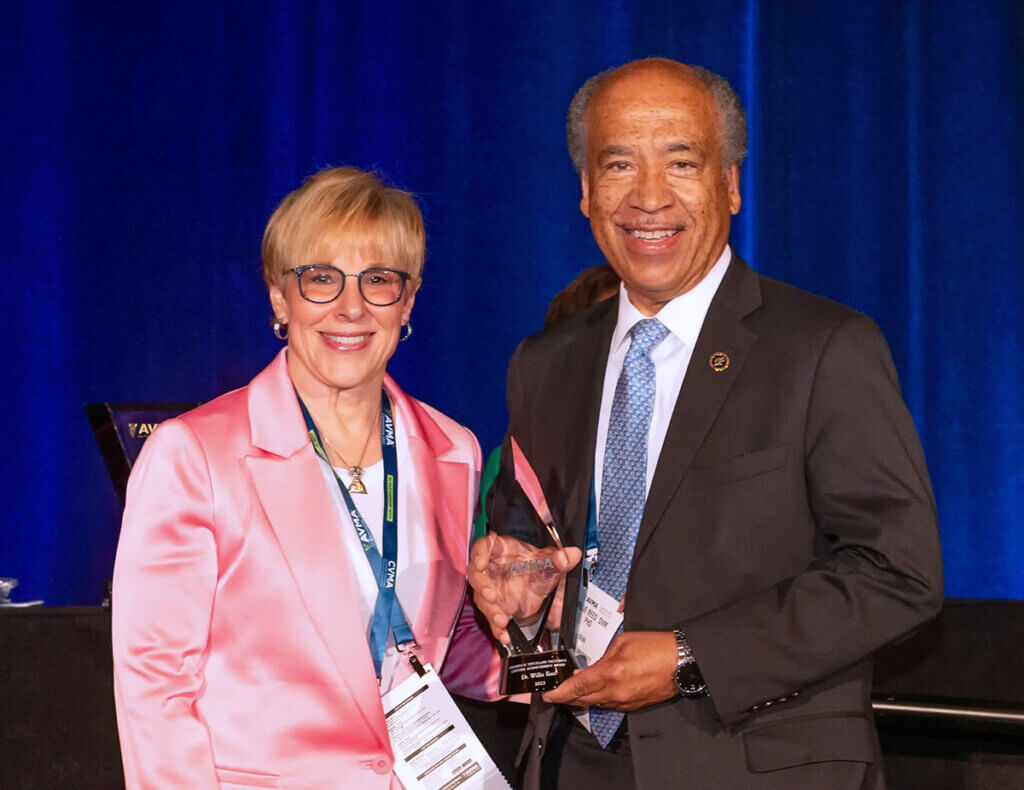
Among his many honors, Dean Reed received an honorary Doctor of Science degree from the Royal Veterinary College, University of London, in 2018, “For his powerful advocacy on behalf of groups underrepresented in veterinary medicine and for his leadership in veterinary medical education and research.”
Under Dean Reed’s leadership, the College of Veterinary Medicine has received the national Health Professions Higher Education Excellence in Diversity (HEED) Award from INSIGHT Into Diversity magazine four times (2017, 2020, 2021, 2022). In 2021, the college was further honored with the Diversity Champion Award – the first time the publication named a veterinary college as a recipient of the award – for demonstrating an outstanding commitment to diversity and inclusion. Diversity Champions are typically institutions known for visionary leadership, that serve as role models and set the standard for thousands of other college campuses striving for inclusive excellence. These institutions are recognized for exemplifying an unyielding commitment to diversity and inclusion throughout their campus communities, across academic programs, and at the highest administrative levels.
The AVMA serves more than 100,000 member veterinarians and is dedicated to improving the health and wellbeing of animals, humans, and the environment. Founded in 1863 and with members in every U.S. state and territory and more than 60 countries, the AVMA is one of the largest veterinary medical organizations in the world. Informed by its members’ unique scientific training and clinical knowledge, the AVMA supports the crucial work of veterinarians and advocates for policies that advance the practice of veterinary medicine and improve animal and human health.
Dr. Frederick Douglass Patterson (1901-1988) received his DVM degree in 1923 from Iowa State University and a PhD in 1931 from Cornell University. He became president of the Tuskegee Institute and oversaw its development into Tuskegee University. While president, Dr. Patterson founded both the Tuskegee University College of Veterinary Medicine and the United Negro College Fund (UNCF) in 1944.
Click here to see the award story published by the AVMA, which includes a video clip from Dean Reed’s acceptance speech.
