
Ophthalmology Service Provides Care to White Tiger Victim of “Tiger King”

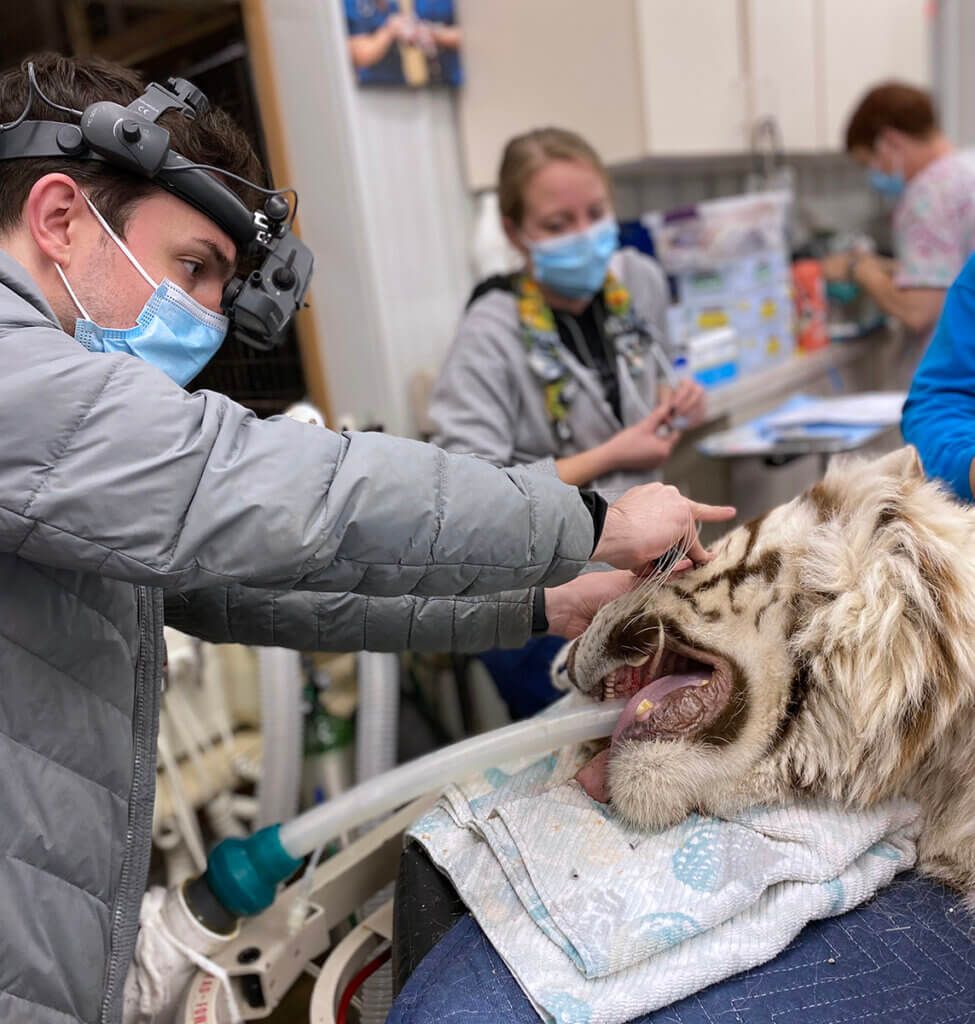
Levi examines Prince's eyes while the tiger is intubated lying on an exam table
Dr. Levi Smith, a second-year ophthalmology resident, examines Prince’s eyes while the white tiger is under general anesthesia for a dental examination.

The Purdue University Veterinary Hospital Ophthalmology Service recently hit the road to examine a white tiger named Prince at the Black Pine Animal Sanctuary in Albion, Indiana after his caretakers noted changes to his vision. Timing their visit to coincide with a volunteer event during which the animals in the sanctuary received dental examinations, the Ophthalmology care team was able to examine the eyes of some of the animals while they were under general anesthesia for the dentals. When the team completed a full ophthalmic examination on Prince, they determined that he has retinal dysfunction in one eye and a cataract in the other, causing him to be non-visual. 

Prince has been a resident of Black Pine Animal Sanctuary since 2020, when he was rescued from the Greater Wynnewood Exotic Animal Park in Wynnewood, Oklahoma. Famously owned and operated by Joseph Allen Maldonado aka “Joe Exotic”, a media personality and convicted felon made famous as the star of the Netflix series “Tiger King” released at the start of the COVID-19 pandemic, the park closed to visitors in October 2020 following a lawsuit and animal welfare investigation. Over 60 lions, tigers, and other big cats were rescued from the animal park after federal inspectors found the animals were suffering from poor living conditions and insufficient veterinary care. “Prince’s eye problems are a direct result of the inbreeding that occurred to get his white coat, and are unfortunately a very common problem seen in white tigers,” explained Kelsi Nicholson, senior keeper at Black Pine Animal Sanctuary. “Prince will live out the rest of his life happily and comfortably at Black Pine Animal Sanctuary where he will receive exceptional care.”
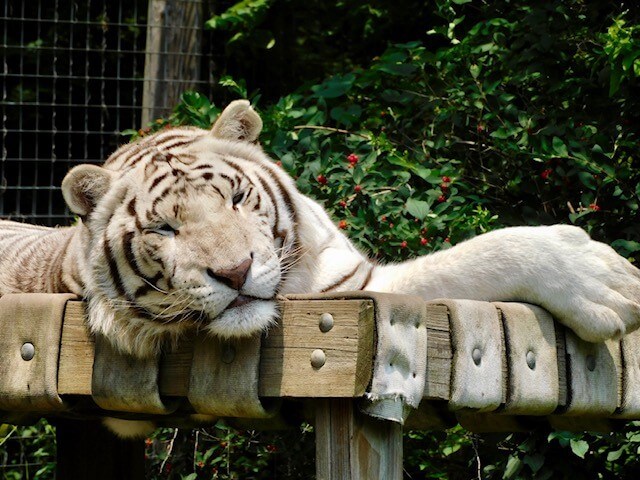
Prince lies outside in the sunshine on a platform in an enclosure at Black Pine Animal Sanctuary
A resident of Black Pine Animal Sanctuary located in Albion, Indiana, Prince benefited from the expert care of the Purdue University Veterinary Hospital’s Ophthalmology Service when the team visited the sanctuary recently. (Photo provided by Black Pine Animal Sanctuary)

With the generosity of his amazing care team, including PVM Professor of Ophthalmology Wendy Townsend; Dr. Levi Smith, ophthalmology resident; and Pam Kirby, RVT, VTS (Ophthalmology), lead veterinary technician, the Purdue Ophthalmology Service is working to coordinate logistics to perform cataract-removal surgery. That should help Prince’s vision improve so he can spend the rest of his life happy and visual at the sanctuary.

Black Pine Animal Sanctuary is a non-profit organization that houses and cares for over 60 species of animals, reptiles, and birds. The animal residents that come to the sanctuary have either been surrendered by owners or confiscated by legal authorities due to neglect or illegal possession. One of the only multi-species sanctuaries in the Midwest, Black Pine is accredited by the Global Federation of Animal Sanctuaries, which documents that the animals receive the highest standard of care.

Writer(s): Allison Gardner | pvmnews@purdue.edu

Recent Stories

Retreat brings together Veterinary Technology team members 

Members of the Purdue Veterinary Technology Distance Learning (VTDL) Program team recently traveled to Purdue’s West Lafayette campus for an in-person retreat where they could work together and explore new opportunities for teaching, learning, and student success. The two day retreat focused on strengthening collaboration between the program's remote and on-campus teams, and represented a significant milestone for the program.

Annual Purdue Veterinary Conference draws veterinary professionals from across the country for learning and fun

The 2026 edition of the annual Purdue Veterinary Conference attracted attendees from around the U.S. for three days of educational sessions covering an array of topics.  With the overall theme of “One Health: Modern Veterinary Medicine,” the conference September 23-26 on the Purdue University campus drew more than 450 veterinarians and veterinary technicians, plus faculty, staff and students. Sessions taught by a total of 65 speakers, including many Purdue Veterinary Medicine clinicians and veterinary technicians/technologists, enabled conference-goers to earn up to 23 continuing education credit hours.

Significant Gift from Jordan Smelski Foundation will fuel Purdue Veterinary Medicine research on deadly brain eating amoeba

A researcher in the Purdue University College of Veterinary Medicine’s Department of Comparative Pathobiology has received a generous gift of more than $100,000 from the Jordan Smelski Foundation for Amoeba Awareness and Mr. Steve Smelski to support research of the deadly amoeba Naegleria fowleri. Christopher Rice, PhD, assistant professor of parasitology and principal investigator of the Rice Research Group, leads a research team seeking to discover and repurpose drugs against primary amoebic meningoencephalitis (PAM), a rare but typically fatal infection caused by Naegleria fowleri.

Purdue veterinary student receives Sir John D. Spurling Scholarship awarded by AKC Humane Fund

The AKC® Humane Fund, Inc.℠ has announced the 2026 recipients of the Sir John D. Spurling Scholarship, celebrating the human-canine bond, and one of the recipients is Purdue veterinary student Tiffany Chang of the Class of 2027. Chang is one of only five students chosen for the scholarships.

Purdue Veterinary Medicine Unites with Purdue United Way Campaign

With the goal of raising $700,000 by November 4 to support local nonprofit organizations that help individuals and families in Greater Lafayette, the Purdue United Way campaign took off September 23 with an official campaign launch on the front lawn of the Purdue Memorial Union. Purdue Veterinary Medicine, along with the university’s other colleges and units, will participate with the help of PVM faculty and staff ambassadors working to make it easy for people in the college to respond, whether by giving, or by indicating that they do not wish to give. As part of the PVM drive to support the campaign, Dean Bret Marsh and his wife, Polly, are contributing a match for campaign contributions from college faculty and staff. Additionally, a drawing will be held to select winners from those who contribute.