
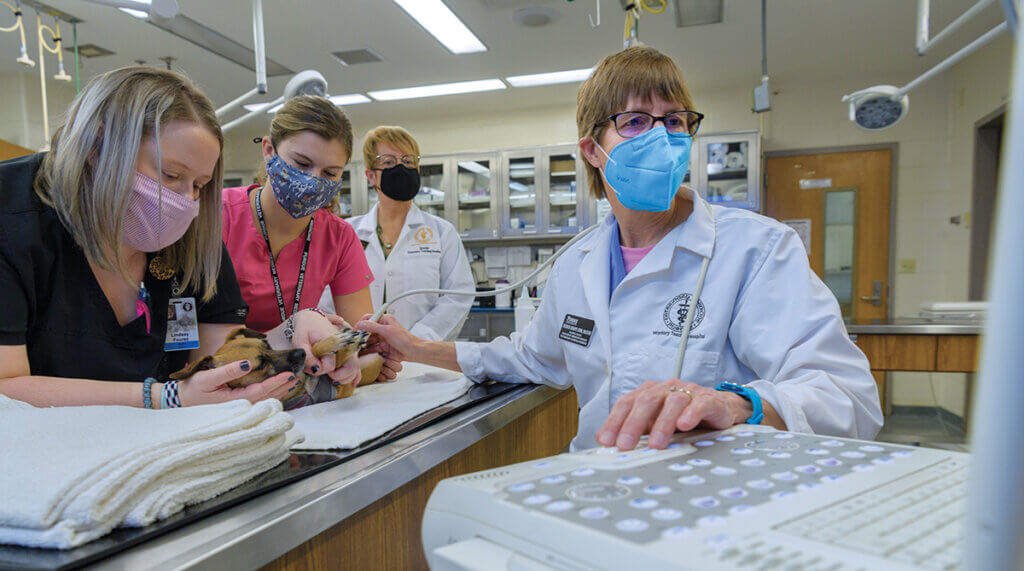
As one of only seven basic laboratory cancer centers recognized by the National Cancer Institute, which is part of the National Institutes of Health, the Purdue University Center for Cancer Research (PCCR) connects more than 110 researchers from across the university, including faculty in the College of Veterinary Medicine. As the only NCI basic laboratory cancer center that includes a college of veterinary medicine, PCCR has the unique opportunity to study canine oncology while giving dogs chances to live longer, fuller lives.
“We actually treat canine cancers,” said Dr. Timothy L. Ratliff, the Robert Wallace Miller Director of the PCCR and Distinguished Professor of Comparative Pathobiology in the College of Veterinary Medicine. “Pet owners are ecstatic that we can extend the lives of their pets, and we utilize this process to better understand cancer in people,” Dr. Ratliff said.
One of the researchers involved in the PCCR is Dr. Deborah Knapp, the Dolores L. McCall Professor of Comparative Oncology in the College of Veterinary Medicine and 2017 Purdue Research Foundation Innovator Hall of Fame inductee. Dr. Knapp has recognized bladder cancer in dogs as the most relevant model for invasive bladder cancer in humans. By treating canine patients, Purdue’s researchers can observe therapies in clinical settings comparable to human circumstances.
The PCCR, which celebrated its 40th year as an NCI-recognized member in 2018, recently received a five-year accreditation extension as part of the competitive renewal of its NCI basic laboratory cancer center status. The work in the PCCR’s labs advances understandings of cancer prevention, detection, diagnosis, and treatment. Researchers study cancer on the cellular level – a form of molecular research that is the foundation of all drug discovery. “We study normal cell function in very basic systems like yeast, fruit flies, and zebrafish,” said Dr. Ratliff. “They’re simple models that help us define pathways quite rapidly and effectively.”
PCCR also advances technologies in cancer detection, imaging, and treatment thanks to the university’s roster of experts in engineering and related fields. Engineering and physics methods allow the production of tools that improve effectiveness of cancer-related drugs. Other innovations allow cancer researchers to better understand the cellular changes that happen in tumor formation. Collaborations such as these are unusual for academic institutions. “Only MIT [Massachusetts Institute of Technology] has a similar marriage with engineering,” Dr. Ratliff said.
PCCR researchers also work diligently to move discoveries out of the lab and into public use in conjunction with the Purdue Institute for Drug Discovery. Because investigating the safety and efficacy of drugs is an expensive, time-consuming process, Dr. Ratliff co-founded Boilermaker Health Innovations, a certified nonprofit that helps fund Purdue-discovered drugs through human clinical trials. Compounds that make it through a Phase I trial can often be sold to an established pharmaceutical manufacturer or spun off into a for-profit company.
One of the center’s most recognized success stories is Endocyte Inc., a startup originating from the work of PCCR member Philip S. Low, co-founder of Boilermaker Health Innovations, Presidential Scholar in Drug Discovery and the Ralph C. Corley Distinguished Professor of Chemistry. Dr. Low’s research, which focuses on providing direct-targeted treatment to diseased cells through the creation of small molecules, helped the biopharmaceutical company reach its $2.2 billion value. PCCR was instrumental in advancing a key targeting molecule by initiating a Phase 0 clinical trial that had such positive results it was a critical drug that contributed significantly to the sale of Endocyte Inc., Dr. Ratliff said.
Click here to view a complete news release about the PCCR and its ongoing research.
