
The challenges faced during the public health crisis brought about by COVID-19 in 2020 have spawned numerous stories. Caring for a sick pet certainly is among the experiences made more complicated by pandemic induced changes. Those changes include the necessary, but difficult, distancing that must be maintained to provide safe care to clients and patients of the Purdue University Veterinary Hospital. While global resilience will be needed to weather this pandemic, there’s good reason to also celebrate the stories of resilient families and pets that have faced illness during this public health crisis.
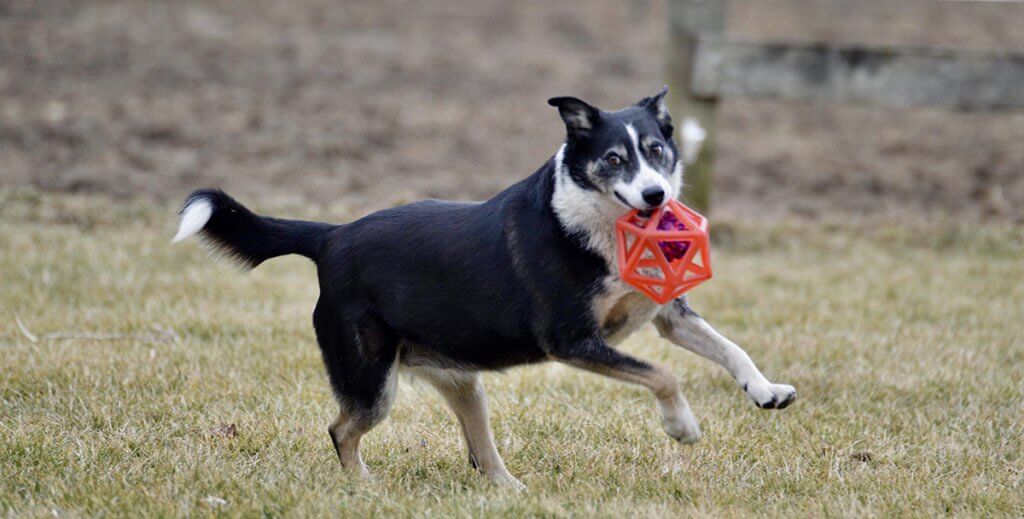
One such story of resilience is that of Sheeba the dog. Sheeba has been a part of the Veterinary Hospital’s family since she first arrived at the Emergency Service on April 25. Sheeba is a ten-year-old Border Collie that was extremely weak, feverish, and uninterested in food or normal activity when she was brought to the hospital. She was found to be severely anemic, meaning she had a dangerously low number of red blood cells. She was so unstable that she required an immediate blood transfusion to supply her body with much needed oxygen.
After an initial evaluation, Sheeba was transferred to the hospital’s Small Animal Internal Medicine service, where an investigation into the cause of her anemia revealed an autoimmune disease known as immune-mediated hemolytic anemia (IMHA) in which the immune system attacks and destroys the dog’s own red blood cells. This condition resulted in severe anemia and a severe inflammatory response within her body. In Sheeba’s case, as is often true with this disease, no apparent cause for this inappropriate immune response was found. Therefore, the mainstay of treatment involves the use of potent immune-suppressive medications to slow and hopefully cease the destruction being coordinated by the defective immune cells.
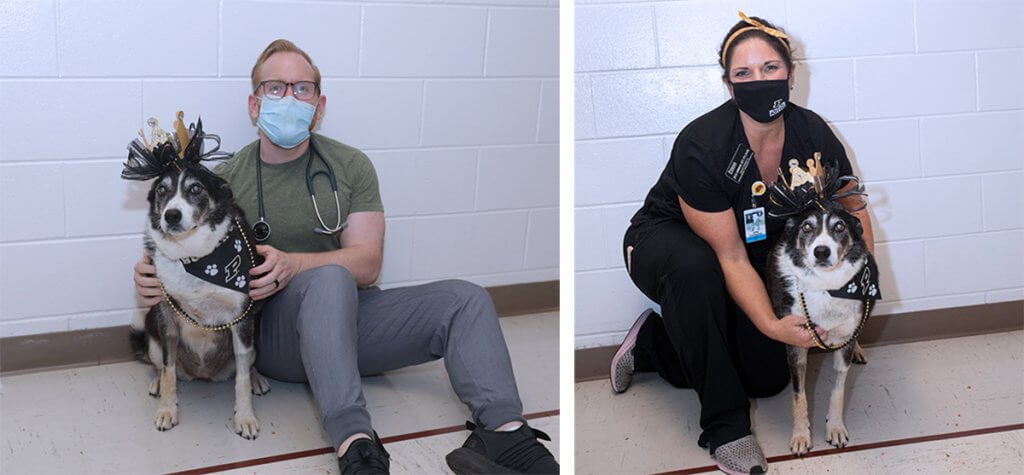
Sheeba’s family was committed to her care, and supported her through her hospitalization in hopes that intensive care would allow her to come home to them. During her hospitalization, Sheeba required a second blood transfusion as her body continued to fight and as the immune-suppressive medications took effect. Finally, Sheeba was able to be discharged from the hospital May 1, six days after her admission, as she was on her road to recovery.
The process of recovering from IMHA is not fast, however. Unfortunately IMHA is not a curable disease. Instead, it is a disease that can go into remission with proper care, after which regular follow-up is required to monitor for a possible relapse.
Sheeba’s immune-suppressive medications included a commonly used steroid called prednisone. While this medication is rapid-acting and effective, it also causes many side effects like increased thirst and hunger, as well as more detrimental side effects when used at high doses for long periods of time. In IMHA, when remission is achieved, the goal of therapy is to slowly decrease the dose of this steroid to maintain control of the disease, while also reducing side effects. For Sheeba, this process would involve frequent recheck appointments at Purdue every couple of weeks to monitor her red blood cell count.
Sheeba definitely made this process interesting! “We always enjoyed the stories of Sheeba’s antics while on steroids,” said Julie Commons, RVT, VTS (SAIM), small animal nephrology/urology technologist. Sheeba’s mom described her already healthy appetite as having become ravenous. She proved this to be true early in her treatment when she consumed over two pounds of raw bacon which resulted in an unexpected visit to Purdue’s Emergency service. “While one would hope Sheeba would have learned her lesson after the bacon incident, we understand that she can ‘neither confirm nor deny’ that another incident involving some hamburgers and bratwurst took place at a cookout,” Julie added.
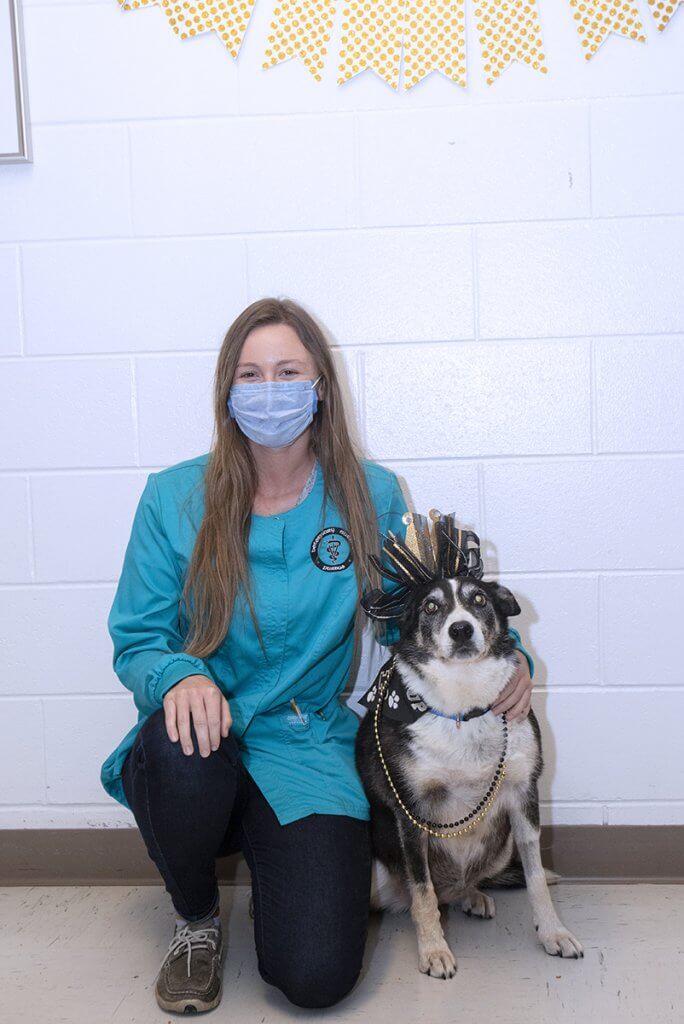
“Over the last four to five months, as the structure and protocols of the Purdue Veterinary Hospital shifted and changed in response to the pandemic, Sheeba and her family were a wonderful constant,” said Dr. Andrew Woolcock, assistant professor of small animal internal medicine in the College of Veterinary Medicine’s Department of Veterinary Clinical Sciences. “Sheeba’s family would bring her every couple of weeks and entertain us with stories as Sheeba continued to show improvement. At each visit, we celebrated as Sheeba’s medications were consistently reduced and her disease remained dormant. We also got to celebrate the news that Sheeba’s human sister, Justine, was accepted to Purdue’s Veterinary Nursing Program, and now has joined our PVM family as a student this fall.”
On Friday, September 25, with Sheeba’s disease remaining stable, her medical team was able to discontinue her prednisone therapy. “It’s a wonderful milestone in her disease, and we’ve watched as her side effects have decreased and she’s returned to her normal self and her normal routine,” Dr. Woolcock said. “While this means we won’t get to see Sheeba and her family as often, we will continue to monitor her progress over time, and will be happy knowing she’s healthy and home with her family that loves her. We wish Sheeba and her family the very best and are thrilled that she has been one of the success stories in this most unusual year of 2020.”
