
Top tier biology journal publishes PVM study that unlocks secrets of a drug-resistant fungal pathogen, which causes serious infections in humans

group of 5 people wearing white lab coats in a laboratory setting
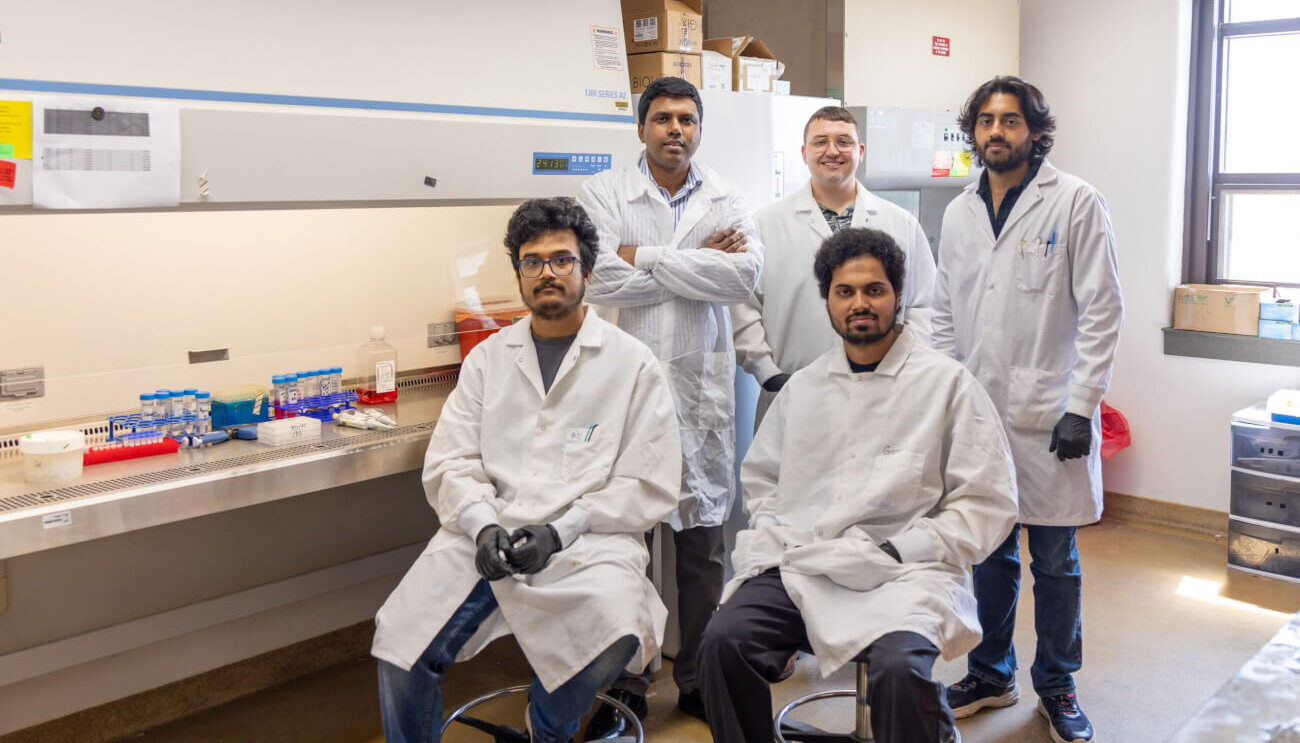
Dr. Shankar Thangamani (back row, left) with his team of PhD students, (front row) Abhishek Datta, Shrihari M G, (back row) Garrett Bryak, and Abishek Balakumar. (Purdue University photo/Ashley Jensen)

Though the name “Candida auris” is far from a household term, public health experts know it well because the multi-drug-resistant fungal pathogen, which causes serious human infections, has been classified as an urgent threat by the U.S. Centers for Disease Control and Prevention (CDC) Antibiotic Threats Report (2019). Dr. Shankar Thangamani, Associate Professor of Microbiology and University Faculty Scholar in the Purdue University College of Veterinary Medicine’s Department of Comparative Pathobiology, is researching C. auris, aided by a 2.4 million grant from the National Institutes of Health (NIH).  

Research findings, just published in Nature Microbiology, show how C. auris adapts and evades the immune system. This study is a collaborative work by two labs: the Thangamani team at Purdue and the Traven team from Monash University in Melbourne, Australia. The study identified that C. auris uses nutrient sensing to tune its virulence traits and modulate immune activation in changing environments. In a glucose-rich environment, such as in the blood, C. auris suppresses its virulence traits and evades immune detection. Conversely, non-fermentable carbon sources prevalent in skin, such as lactic acid, activate adhesion and filamentation, thereby triggering macrophage responses. C. auris dials up or down its potential for virulence and controls proportional immune responses. Metabolic flexibility enables C. auris to optimize a critical trade-off: expressing virulence traits while minimizing immune recognition to colonize host tissues. These findings have significant implications in understanding how C. auris adapts within the host environment, which could open the door to developing novel antifungal therapeutics.

Previous work by the Thangamani team has also included two major studies published in PLOS Pathogens, a premier journal in host-pathogen interaction research. The researchers employed unbiased single-cell transcriptomics of murine skin infected with C. auris to identify cell-type-specific immune responses, as reported in a study published in PLOS Pathogens in 2024. In the subsequent study, Thangamani’s team found that, unlike Candida albicans, a closely related fungal pathogen that induces protective IL-17-producing T cells, C. auris predominantly induces IFNγ-secreting pathogenic Th1 cells during reinfection. The surprising conclusion was that IFNγ enhances skin infection by C. auris but not by C. albicans. These findings were also published in PLOS Pathogens in 2025.

Dr. Thangamani said these results enhance the understanding of host defense and immune evasion mechanisms during C. auris skin infection, which aids in understanding the pathogenesis of this emerging fungal pathogen and in developing novel antifungal therapeutics to prevent and treat C. auris infections in humans.

Writer(s): PVM News | pvmnews@purdue.edu

Recent Stories

“Paws Up” for Jennifer Danaher – brought to you by the PVM Wellness Committee

This week we express our gratitude to Jennifer Danaher, who is department secretary for Veterinary Clinical Sciences.

‘Purdue Pursuits’: A PVM angle on Purdue’s teaching and learning reading groups

Crafting meaningful and engaging course experiences has been at the top of Dielson Vieira’s mind ever since he joined the Purdue University College of Veterinary Medicine’s faculty in 2024. As a clinical assistant professor in the Department of Basic Medical Sciences, Vieira is already adept at applying innovative teaching practices to classroom environments, but that doesn’t stop him from seeking out new ideas, approaches and perspectives — insights he gains through outlets like Purdue’s teaching and learning reading groups.

In Print: ‘Translational Research Methods for Tauopathies’

A just-published 300-page volume edited by Jessica Fortin, Purdue assistant professor in the College of Veterinary Medicine’s Department of Basic Medical Sciences, provides a significant new resource for researchers studying a group of neurodegenerative diseases known as tauopathies. “Translational Research Methods for Tauopathies” provides detailed protocols intentionally selected to serve as a basis for research laboratories seeking to further treatments for such debilitating neurodegenerative diseases as Alzheimer’s and chronic traumatic encephalopathy (CTE).

It’s Almost Here!

Though the annual Purdue Veterinary Conference is almost upon us, there’s still time to register and take advantage of this time-honored College of Veterinary Medicine fall tradition that combines excellent continuing education with fun opportunities for reconnecting with colleagues and classmates, networking, and learning about the latest veterinary trends and products. The 2026 Purdue Veterinary Conference takes place September 23–26 on the Purdue University campus. The annual event has something for everyone, from veterinarians to veterinary technicians, faculty, staff and students.

New academic year begins with “Launch” for PVM Students

As the Purdue University campus began to awaken from the relative quiet of the summer break, the familiar sights and sounds of vet school life returned to the hallways of the College of Veterinary Medicine with “Launch! DVM 2030” – the festive and thorough orientation program for new Purdue veterinary students. Members of the college’s new first-year DVM class, the Class of 2030, began the week of activities, presentations, and social gatherings Monday, August 17.  New Veterinary Technology students got help acclimating to life in Lynn Hall during orientation sessions that coincided with the first days of class.