
Second MOAAR Symposium to Feature Range of Exotic Animal Medicine Experts

MOAAR exotic pet

The Purdue Veterinary Exotic Animal Club (PVEAC) will be hosting the second MOAAR Symposium next weekend, November 9 and 10, with speakers from across the country as well as Central America. MOAAR stands for “Medicine of Aquatics, Amphibians, and Reptiles,” and the goal of the symposium is to educate students about medicine for species that are not focused on as part of their general veterinary studies.

Lydia Hall, third-year DVM student and president of PVEAC, took on the year-long task of organizing the event with her fellow executive board members. They have primarily invited lecturers from around the Midwest, so that students are able to build connections in the region where they likely will practice. But they also have included experts from further away, like Dr. Alejandro Morales, a wildlife veterinarian based in Guatemala who will participate via Skype, and Dr. Cara Field, staff veterinarian for the Marine Mammal Center in Sausalito, Calif.  Dr. Field will serve as the keynote speaker.

“Something that we have really focused on this year is bringing in more types of professionals in the exotic animal field, including veterinary nurses, since we have veterinary nursing students who are interested in that career path,” said Lydia. One the speakers is Abigail Rosenblum, RVT, who worked in aquatic medicine at the Adventure Aquarium in Camden, N.J., before accepting a position at the Indianapolis Zoo.  She is in the midst of obtaining her Veterinary Technician Specialist certification in zoo medicine.
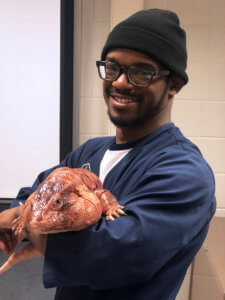
Evan holds a large red tegu lizard
Purdue Veterinary Exotic Animal Club member Evan Carter-Taylor, of the DVM Class of 2021, holds a red tegu lizard.

PVEAC has over 70 members with a variety of career interests, ranging from zoo medicine to exotic animal private practice. There also are members who want to pursue careers in small animal medicine, so the club hosts labs that teach them about treating “pocket pets,” like hamsters, that future clients might bring to their small animal practices.

The MOAAR symposium is open to all Purdue Veterinary Medicine students as well as graduate and undergraduate Purdue students outside of PVM, students from other veterinary schools, and practicing veterinarians and veterinary nurses. The inaugural MOAAR Symposium was held in 2017, with the intent of hosting it every other year.

“This is an exciting opportunity for students from all over, especially since we have speakers from many different places and professional backgrounds,” said Lydia. “There will be lectures on a broad range of topics, from the biology and physiology of cephalopods to anesthesia and analgesia in reptiles. It is a great way to learn about things we are not usually exposed to.”

Writer(s): Maya Sanaba, PVM Communications Intern | pvmnews@purdue.edu

Recent Stories

“Paws Up” for Jennifer Danaher – brought to you by the PVM Wellness Committee

This week we express our gratitude to Jennifer Danaher, who is department secretary for Veterinary Clinical Sciences.

‘Purdue Pursuits’: A PVM angle on Purdue’s teaching and learning reading groups

Crafting meaningful and engaging course experiences has been at the top of Dielson Vieira’s mind ever since he joined the Purdue University College of Veterinary Medicine’s faculty in 2024. As a clinical assistant professor in the Department of Basic Medical Sciences, Vieira is already adept at applying innovative teaching practices to classroom environments, but that doesn’t stop him from seeking out new ideas, approaches and perspectives — insights he gains through outlets like Purdue’s teaching and learning reading groups.

Top tier biology journal publishes PVM study that unlocks secrets of a drug-resistant fungal pathogen, which causes serious infections in humans

Though the name “Candida auris” is far from a household term, public health experts know it well because the multi-drug-resistant fungal pathogen, which causes serious human infections, has been classified as an urgent threat by the U.S. Centers for Disease Control and Prevention (CDC) Antibiotic Threats Report (2019). Dr. Shankar Thangamani, Associate Professor of Microbiology and University Faculty Scholar in the Purdue University College of Veterinary Medicine’s Department of Comparative Pathobiology, is researching C. auris, aided by a 2.4 million grant from the National Institutes of Health (NIH). New research findings, just published in Nature Microbiology, show how C. auris adapts and evades the immune system.

In Print: ‘Translational Research Methods for Tauopathies’

A just-published 300-page volume edited by Jessica Fortin, Purdue assistant professor in the College of Veterinary Medicine’s Department of Basic Medical Sciences, provides a significant new resource for researchers studying a group of neurodegenerative diseases known as tauopathies. “Translational Research Methods for Tauopathies” provides detailed protocols intentionally selected to serve as a basis for research laboratories seeking to further treatments for such debilitating neurodegenerative diseases as Alzheimer’s and chronic traumatic encephalopathy (CTE).

It’s Almost Here!

Though the annual Purdue Veterinary Conference is almost upon us, there’s still time to register and take advantage of this time-honored College of Veterinary Medicine fall tradition that combines excellent continuing education with fun opportunities for reconnecting with colleagues and classmates, networking, and learning about the latest veterinary trends and products. The 2026 Purdue Veterinary Conference takes place September 23–26 on the Purdue University campus. The annual event has something for everyone, from veterinarians to veterinary technicians, faculty, staff and students.