
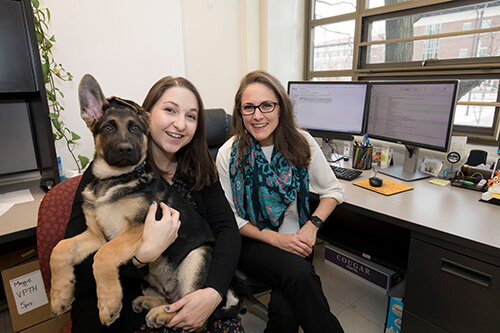
Dr. Maggie O’Haire, PVM assistant professor of human-animal interaction, with Kerri Rodriguez, human-animal interaction graduate student in PVM’s Department of Comparative Pathobiology, and her dog Hendrix.
By Megan Huckaby, Purdue News Service and Kevin Doerr
A preliminary study led by researchers in the Purdue University College of Veterinary Medicine has shown that overall symptoms of post-traumatic stress disorder (PTSD) are lower among war veterans with service dogs. The pilot study was co-funded by the Human Animal Bond Research Institute (HABRI) and Bayer Animal Health.
The study was led by Assistant Professor of Human-Animal Interaction Maggie O’Haire, in the Department of Comparative Pathobiology, with the help of K9s For Warriors, an accredited nonprofit organization that provides veterans with service dogs. The pilot research project gives scientific evidence of mental health benefits experienced by veterans with PTSD who have service dogs.
“We found that the group of veterans with service dogs had significantly lower levels of PTSD symptomology than those who did not have a service dog,” Dr. O’Haire says. “They also had lower levels of depression, lower anxiety, and increased social participation, meaning a willingness to leave their house and go engage with society in different activities.” The study is published in the February issue of the Journal of Consulting and Clinical Psychology.
Participants were recruited between November 2015 and February 2016 from a national sample of 304 individuals who applied and were approved to receive a trained PTSD service dog from K9s For Warriors. Of these, 141 individuals chose to participate in the preliminary trial. Approximately half of the sample of participants were on the waitlist to receive a service dog and the other half already had a service dog.
Measurements of various aspects of PTSD symptoms, quality of life, social functioning, and work were analyzed and compared between the two groups. Results reveal that veterans suffering from PTSD exhibited better mental health and well-being on several measures if they had a service dog, including:
- Lower overall symptoms of post-traumatic stress
- Lower levels of depression
- Higher levels of life satisfaction
- Higher overall psychological well-being
- Lower levels of social isolation and greater ability to participate in social activities
- Higher levels of resilience
- Higher levels of companionship
- Less absenteeism from work due to health among those who were employed
The only areas measured in which there was no significant difference between the two groups were physical functioning and employment status.
“This innovative study applied rigorous research methodology to an area that has historically been characterized by a reliance on anecdotal accounts and intuition rather than evidence-based science,” Dr. O’Haire says. Click here to view a video of Dr. O’Haire explaining the study.

Kerri Rodriguez, human-animal interaction graduate student in the Department of Comparative Pathobiology, was co-author of the study. Kerri is part of the Purdue University research group led by Dr. O’Haire, called the Organization for Human-Animal Interaction Research and Education (OHAIRE).
“The results have important implications for understanding the specific areas of life that a PTSD service dog may help improve,” says Kerri. “As the number of service dogs given to veterans with PTSD continues to increase, this is an important first step towards proof of concept that service dogs can actually provide measurable, clinical changes for veterans.” Dr. O’Haire and Kerri also say that service dogs did not replace evidence-based treatment for PTSD, nor did they cure it. While the veterans still had PTSD, they had significantly lower levels of symptoms.
“Pairing service dogs with our nation’s veterans should be recognized as a significant complementary method of treatment,” says HABRI Executive Director Steven Feldman. “The U.S. Department of Veterans Affairs has cited a lack of scientific research supporting service dogs for veterans with PTSD. This study is a significant step in providing scientific documentation, and I hope the promising results from this study will prompt a renewed focus on the benefits that service dogs provide.”
Bayer Animal Health Vice President for Companion Animal Product Marketing David Van Brunt says the lifetime bonds that these service dogs form with their veterans are built on mutual love, care, and devotion. “The results of this study demonstrate not only the impact of this unbreakable bond, but that these service dogs are so much more than service dogs; they are able to bring the joy of living back into veterans’ lives. Bayer is committed to ensuring that these service dogs receive the proper and routine care they need to support their veteran on a daily basis,” David says.
The research team will now move on to a National Institutes of Health-funded research project in which veterans with and without service dogs will be studied for an extended period of time. Dr. O’Haire says the valuable data from the pilot study helped secure the NIH R21 grant to conduct the large-scale, clinical trial to further investigate the efficacy and role of service dogs for military veterans with PTSD and their spouses.
