
PVM Family Program Series “Takes a Peek” at Technology Behind Minimally Invasive Surgeries

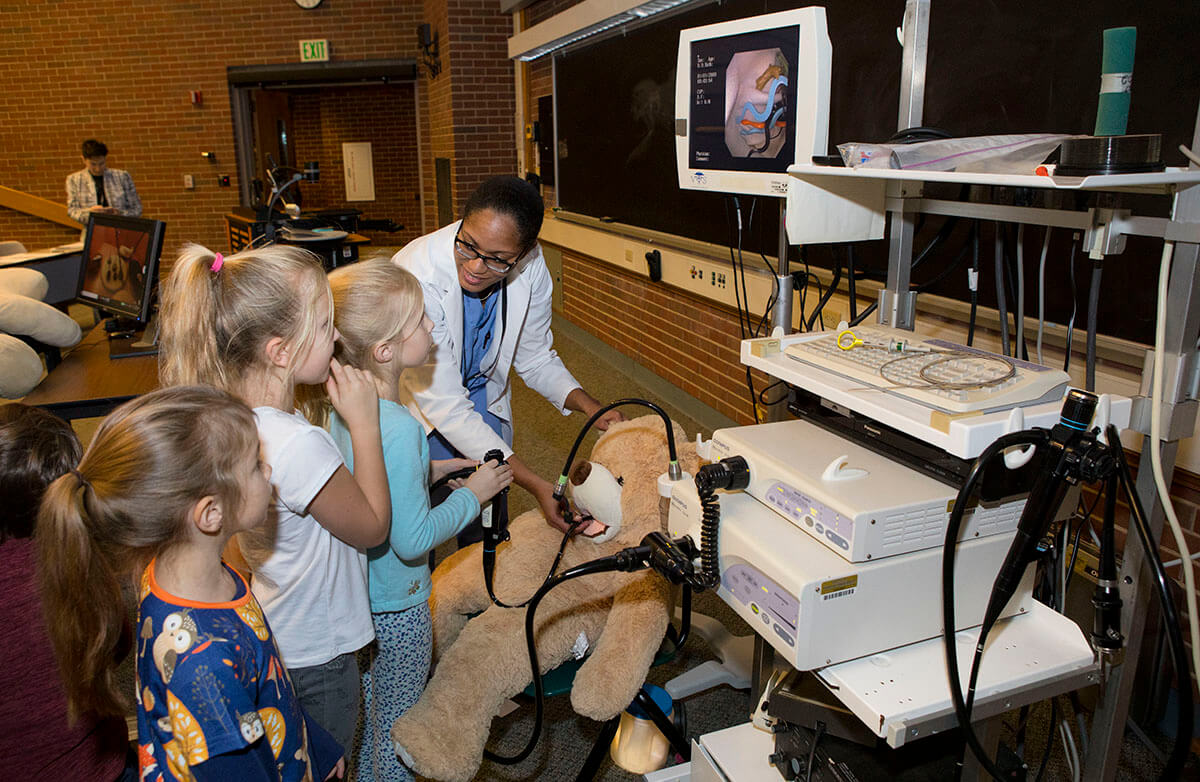
Dr.Simmons with children Dr. Micha Simons, clinical assistant professor of small animal surgery, helps children learn how to use an endoscope with a Teddy Bear during her PVM Family Program Series presentation called “Let’s Take a Peak.”

Children had a chance to play the role of an expert surgeon last week during the second of three sessions that are part of the PVM Family Program Series.  “Let’s Take a Peek” was the title of the presentation Thursday, November 1, by Dr. Micha Simons, clinical assistant professor of small animal surgery.  Dr. Simons demonstrated how tiny cameras can be used for diagnostic purposes and to perform minimally invasive surgeries.

More than 40 people attended the interactive session that was designed especially for children.  Four veterinary students assisted Dr. Simons as she gave the children hands-on opportunities to work with the high tech equipment.  Dr. Simons also taught the attendees about the different types of cameras used for different types of procedures and surgeries, including thoracoscopy and endoscopy. The children were able to try out their own skills by inserting an endoscope inside a large teddy bear’s mouth and down to a simulated stomach, where they could see what the teddy bear had “eaten” – in this case anything from plastic toy horses to toy snakes.
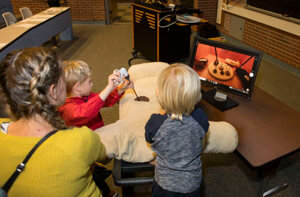
A parent watches as children work with special tools used in minimally invasive surgery, and seek to grab one of the small candy pieces situated inside a stuffed animal.

A parent watches as children work with special tools used in minimally invasive surgery, and seek to grab one of the small candy pieces situated inside a stuffed animal.

The children who participated mentioned that their favorite part was being able to use the cameras themselves. The event also generated positive feedback from parents.

The next event in the PVM Family Program Series will be on March 7, when Liane Shaw, RVT, diagnostic imaging instructional technologist, leads a presentation entitled, “Don’t Give Dental Care the Bush Off.” The talk will include discussion about the teeth of various species, and how veterinarians and veterinary nurses care for them. Liane also will teach audience members about how to care for their own pet’s teeth.

Writer(s): Amanda McCormick, PVM Communications Intern, and Kevin Doerr | pvmnews@purdue.edu

Recent Stories

“Paws Up” for Jennifer Danaher – brought to you by the PVM Wellness Committee

This week we express our gratitude to Jennifer Danaher, who is department secretary for Veterinary Clinical Sciences.

‘Purdue Pursuits’: A PVM angle on Purdue’s teaching and learning reading groups

Crafting meaningful and engaging course experiences has been at the top of Dielson Vieira’s mind ever since he joined the Purdue University College of Veterinary Medicine’s faculty in 2024. As a clinical assistant professor in the Department of Basic Medical Sciences, Vieira is already adept at applying innovative teaching practices to classroom environments, but that doesn’t stop him from seeking out new ideas, approaches and perspectives — insights he gains through outlets like Purdue’s teaching and learning reading groups.

Top tier biology journal publishes PVM study that unlocks secrets of a drug-resistant fungal pathogen, which causes serious infections in humans

Though the name “Candida auris” is far from a household term, public health experts know it well because the multi-drug-resistant fungal pathogen, which causes serious human infections, has been classified as an urgent threat by the U.S. Centers for Disease Control and Prevention (CDC) Antibiotic Threats Report (2019). Dr. Shankar Thangamani, Associate Professor of Microbiology and University Faculty Scholar in the Purdue University College of Veterinary Medicine’s Department of Comparative Pathobiology, is researching C. auris, aided by a 2.4 million grant from the National Institutes of Health (NIH). New research findings, just published in Nature Microbiology, show how C. auris adapts and evades the immune system.

In Print: ‘Translational Research Methods for Tauopathies’

A just-published 300-page volume edited by Jessica Fortin, Purdue assistant professor in the College of Veterinary Medicine’s Department of Basic Medical Sciences, provides a significant new resource for researchers studying a group of neurodegenerative diseases known as tauopathies. “Translational Research Methods for Tauopathies” provides detailed protocols intentionally selected to serve as a basis for research laboratories seeking to further treatments for such debilitating neurodegenerative diseases as Alzheimer’s and chronic traumatic encephalopathy (CTE).

It’s Almost Here!

Though the annual Purdue Veterinary Conference is almost upon us, there’s still time to register and take advantage of this time-honored College of Veterinary Medicine fall tradition that combines excellent continuing education with fun opportunities for reconnecting with colleagues and classmates, networking, and learning about the latest veterinary trends and products. The 2026 Purdue Veterinary Conference takes place September 23–26 on the Purdue University campus. The annual event has something for everyone, from veterinarians to veterinary technicians, faculty, staff and students.