
PVM Family Program Series Introduces Kids to Inner Workings of the Brain

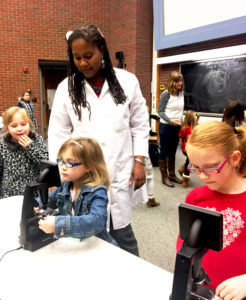
Dr. Tiffany Lyle with Family Program Series participants

Dr. Tiffany Lyle observes as PVM Family Program Series participants use microscopes to look at slides of muscle, brain, skin, and liver tissue.

The Purdue University College of Veterinary Medicine hosted the third Family Program Series for the year on Thursday, March 1, entitled “Breaking through Barriers in the Brain,” featuring a presentation by Dr. Tiffany Lyle, assistant professor of veterinary anatomic pathology in the Department of Comparative Pathobiology. The PVM Family Program series is designed for families with young children who are interested in learning more about the veterinary profession.

Dr. Lyle made an entrance wearing her white lab coat and stethoscope. She later removed the stethoscope, to show that not all veterinarians use stethoscopes, but still get to work with animals and make a difference in the world of veterinary science. About 50 attendees participated in several engaging pathology-related activities including: a snowflake demonstration that illustrated how no two diseases are exactly the same; a cheese demonstration that helped children think outside the box as they examined the physical properties of a disease; a “brain dissection” performed with a tangerine; and hands-on learning with microscope slides of muscles, parts of the brain, skin, and liver. At the end of the program, attendees were given a free book and veterinary trading cards to take home.

The next Family Program Series event will take place Thursday, April 5, from 6:00 – 7:00 p.m.  Veterinary Technology Program Director Bianca Zenor will present, “Animals Have Nurses, Too,” sharing how veterinary technicians help pets, their families, and veterinarians.

Writer(s): Helen Thimlar, PVM Communications Intern | pvmnews@purdue.edu

Recent Stories

“Paws Up” for Jennifer Danaher – brought to you by the PVM Wellness Committee

This week we express our gratitude to Jennifer Danaher, who is department secretary for Veterinary Clinical Sciences.

‘Purdue Pursuits’: A PVM angle on Purdue’s teaching and learning reading groups

Crafting meaningful and engaging course experiences has been at the top of Dielson Vieira’s mind ever since he joined the Purdue University College of Veterinary Medicine’s faculty in 2024. As a clinical assistant professor in the Department of Basic Medical Sciences, Vieira is already adept at applying innovative teaching practices to classroom environments, but that doesn’t stop him from seeking out new ideas, approaches and perspectives — insights he gains through outlets like Purdue’s teaching and learning reading groups.

Top tier biology journal publishes PVM study that unlocks secrets of a drug-resistant fungal pathogen, which causes serious infections in humans

Though the name “Candida auris” is far from a household term, public health experts know it well because the multi-drug-resistant fungal pathogen, which causes serious human infections, has been classified as an urgent threat by the U.S. Centers for Disease Control and Prevention (CDC) Antibiotic Threats Report (2019). Dr. Shankar Thangamani, Associate Professor of Microbiology and University Faculty Scholar in the Purdue University College of Veterinary Medicine’s Department of Comparative Pathobiology, is researching C. auris, aided by a 2.4 million grant from the National Institutes of Health (NIH). New research findings, just published in Nature Microbiology, show how C. auris adapts and evades the immune system.

In Print: ‘Translational Research Methods for Tauopathies’

A just-published 300-page volume edited by Jessica Fortin, Purdue assistant professor in the College of Veterinary Medicine’s Department of Basic Medical Sciences, provides a significant new resource for researchers studying a group of neurodegenerative diseases known as tauopathies. “Translational Research Methods for Tauopathies” provides detailed protocols intentionally selected to serve as a basis for research laboratories seeking to further treatments for such debilitating neurodegenerative diseases as Alzheimer’s and chronic traumatic encephalopathy (CTE).

It’s Almost Here!

Though the annual Purdue Veterinary Conference is almost upon us, there’s still time to register and take advantage of this time-honored College of Veterinary Medicine fall tradition that combines excellent continuing education with fun opportunities for reconnecting with colleagues and classmates, networking, and learning about the latest veterinary trends and products. The 2026 Purdue Veterinary Conference takes place September 23–26 on the Purdue University campus. The annual event has something for everyone, from veterinarians to veterinary technicians, faculty, staff and students.