
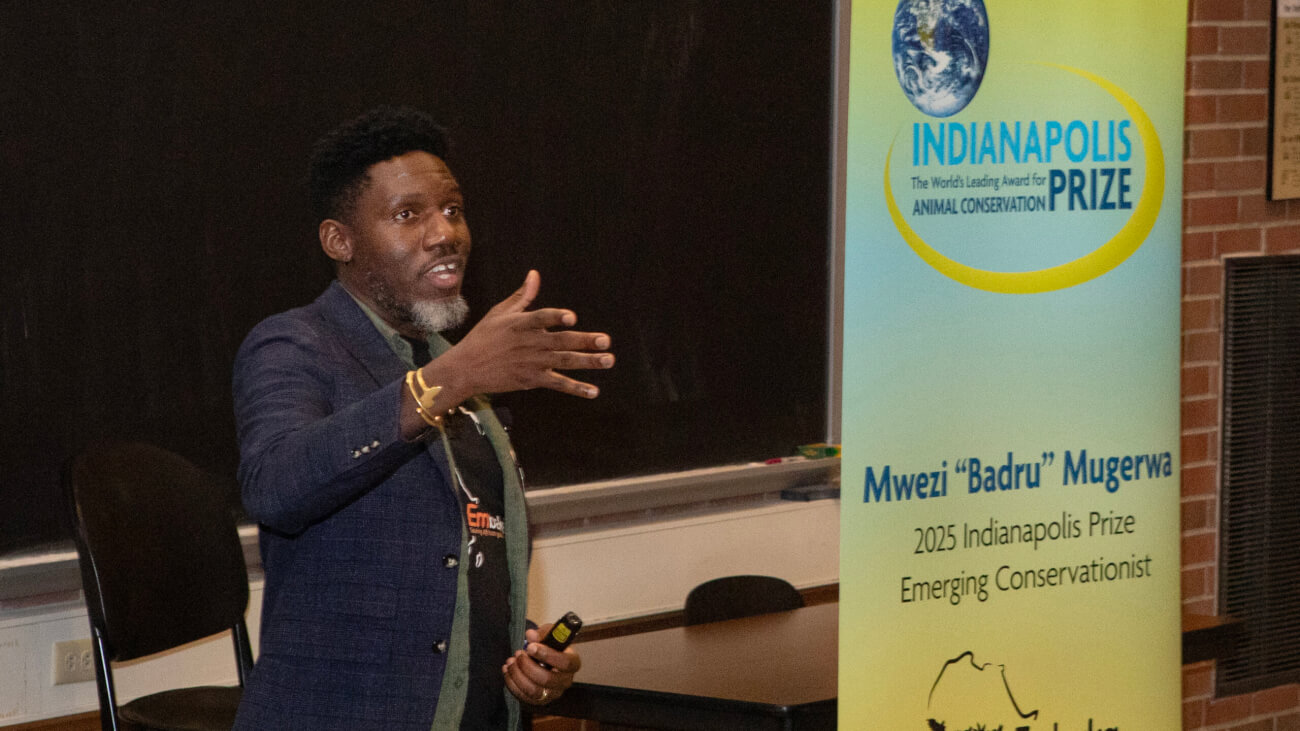
PVM Collaborates with Indianapolis Zoo to Host Emerging Conservationist Award Winner at Lynn Hall

Indianapolis Prize Emerging Conservationist Award winner Mwezi “Badru” Mugerwa speaks to veterinary students at Lynn Hall Monday, September 29.

Purdue veterinary students had a unique chance this week to hear first-hand from one of the world’s leading conservationists who is making a significant impact while still early in his career.  Through a collaborative arrangement with the Indianapolis Zoo, the College of Veterinary Medicine hosted a visit by Mwezi “Badru” Mugerwa, the winner of the 2025 Indianapolis Prize Emerging Conservationist Award, on Monday, September 29, so he could share his message with Purdue DVM students. 

The Emerging Conservationist Award, which comes with a $50,000 prize, recognizes a conservationist under 40 who has made a significant impact on saving an animal species or group of species. Mugerwa is a Ugandan conservationist, researcher, and the founder and director of Embaka, a grassroots community-based conservation organization focused on the preservation of the African golden cat. 
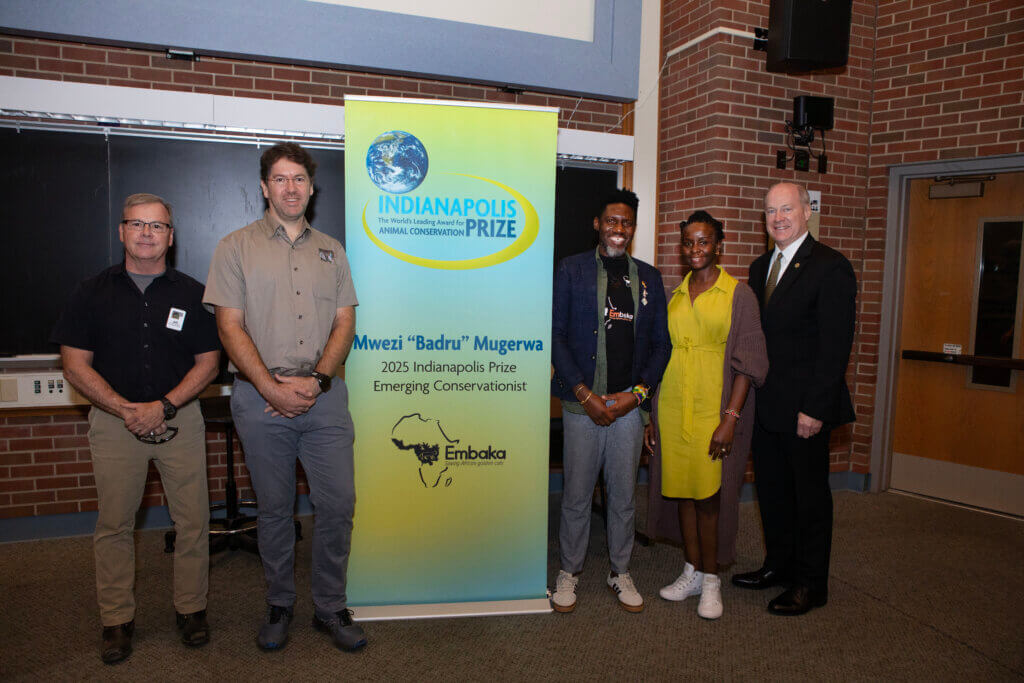
PVM Dean Bret Marsh (right) with Mwezi Mugerwa and his wife as well as Dr. Jeff Proudfoot, (left) Indianapolis Zoo vice president of veterinary services, and Dr. Nico de Bruyn, zoo vice president of conservation & education.

Now a PhD candidate in biology and conservation, Mugerwa established the first-ever community-based anti-poaching conservation project focused on the African golden cat at Bwindi Impenetrable Forest National Park in Uganda. He also created the African Golden Cat Conservation Alliance (AGCCA), a network of African nationals implementing conservation activities for the African golden cat across the species range. Additionally, Mugerwa serves as the president of the Society for Conservation Biology’s Africa Region and is the president-elect for the Society for Conservation Biology Global.

Mugerwa began studying the African golden cat through research using camera traps, during which he captured a black and white image of an unknown animal in the forest. It turned out to be the African golden cat – an elusive species found only in the forests of equatorial Africa. Mugerwa said it was scary when he realized that hunters knew about the golden cat but he and his field assistants did not.  Turning to the community, he came to understand how the wild cat’s primary threat—poaching—was directly connected to the livelihood of local people, as it is often caught in bushmeat snares.
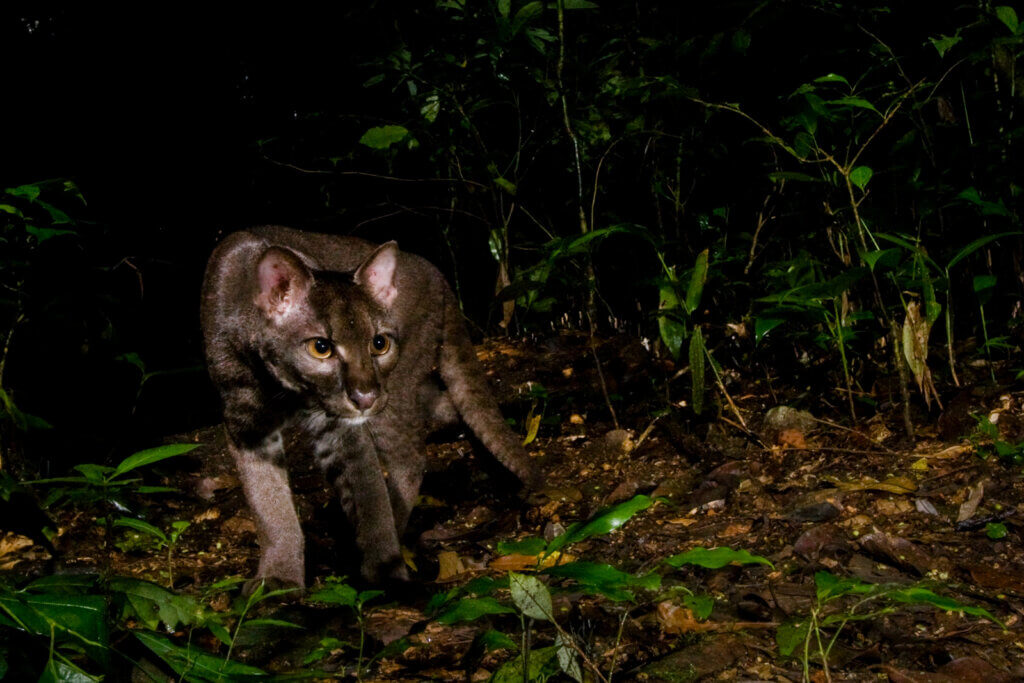
Africa's least known wild cat species, the African golden cat is listed as Vulnerable on the International Union for Conservation of Nature (IUCN)'s Red List of threatened species.
Africa’s least known wild cat species, the African golden cat is listed as Vulnerable on the International Union for Conservation of Nature (IUCN)’s Red List of threatened species.

Mugerwa emphasized that a major challenge today involves a disconnect between people and nature.  They view having a national park in their area as a burden, not an opportunity. He stresses that an important aspect of conservation is engaging with communities, as communities hold the solutions.  But he explains, if you don’t talk to them, you won’t know. 

Mugerwa shared with the students how, since its founding in 2015, Embaka has focused on involving the community in conservation efforts. Through four programs—offering a range of help, from free oral health care and livestock, to assisting with credit and savings for families in exchange for a pledge not to poach—more than 2,225 community members have registered to support the African golden cat.

As for his research, Mugerwa and others now are using artificial intelligence to analyze camera trap data as they work with the AGCCA in 19 African countries to move toward a standardized model of observation to better study the population of African golden cats across the continent. 

Mugerwa was chosen as this year’s recipient of the Emerging Conservationist Award through a two-stage selection process. The biennial award is made possible through a gift from the Kobe Foundation.  Mugerwa is only the second person to receive the Emerging Conservationist Award. 

The formal presentation of this year’s award occurred last weekend during the Indianapolis Prize Gala, presented by Cummins Inc., in downtown Indianapolis, where Dr. Lily-Arison René de Roland, a renowned scientist and biodiversity conservationist in Madagascar, was recognized as the winner of the 2025 Indianapolis Prize.  Also a biennial award, the Indianapolis Prize includes a $250,000 award to support the recipient’s work in animal species conservation.

Writer(s): Kevin Doerr | pvmnews@purdue.edu

Recent Stories

“Paws Up” – brought to you by the PVM Wellness Committee

Behind the scenes, Alicia Williams has been making PVM a kinder, stronger place.

Purdue Veterinary Medicine Computational Biologist Uses Big Data, AI and Math to Find Patterns in Cancer

With recent advances, cancer research now generates vast amounts of information. The data could help researchers detect patterns in cancer cells and stop their growth, but the sheer volume is just too much for the human mind to digest. Enter Nadia Lanman, research associate professor in the Department of Comparative Pathobiology, whose expertise in computational biology helps researchers at Purdue University distill solutions from the sea of numbers.

Purdue to Host Fourth Annual Antimicrobial Conference in February

With leadership by the Purdue University College of Veterinary Medicine, the Fourth Annual Conference on Antimicrobial Resistance (AMR) will be held at Purdue University West Lafayette February 25–26, 2026. With multidrug-resistant infections on the rise globally, this event brings together experts and practitioners across the spectrum of human, animal, and environmental health to address one of today’s most urgent public health challenges.

PVM Well-represented by Humans and Animals During Annual Homecoming Celebrations

Every fall, Boilermakers from near and far return to the campus in West Lafayette for the annual ritual known as Homecoming. And Purdue’s Homecoming events also attract plenty of non-alumni who are Purdue fans, patrons, prospective students, or clients of the Purdue University Veterinary Hospital. During this year’s Homecoming weekend October 24-25, Purdue Veterinary Medicine engaged with attendees in multiple ways, with the help of some furry companions.

Purdue University and Akston Biosciences Bring “First Dose of Hope” in New Cancer Immunotherapy Trial for Dogs with Urinary Bladder Cancer

The Purdue University College of Veterinary Medicine, in partnership with Akston Biosciences Corporation, has initiated the enrollment of dogs with urinary bladder cancer in a clinical trial of a pioneering immunotherapy. The strategic partnership between Purdue and Akston was announced in August after the underlying technology was developed at the College of Veterinary Medicine and the Purdue Institute for Cancer Research (PICR).

“Paws Up” – brought to you by the PVM Wellness Committee

Today we share appreciation for Beth Laffoon, MS, RVT, and Holly McCalip, BS, RVT, who are both instructional technologists in the Veterinary Nursing Program.

MMAS Symposium Brings Participants Face to Face with Specialists and Species from Parrots to Pocket Pets

Thanks to Purdue Veterinary Medicine’s Exotic Animal Club and dedicated faculty, staff and students, nearly 100 in-person and on-line participants got a chance recently to gain valuable knowledge and insight about the Medicine of Mammalian and Avian Species. The two-day educational event known as the MMAS Symposium is a biennial conference, and the 2024 edition held in Lynn Hall November 9 and 10 featured an impressive program that included 22 lectures and several hands-on labs, organized into two tracks focusing on avian and mammalian species.

Veterinary Boilermakers Take Part in Purdue One Health Alumni Reunion

Purdue University College of Veterinary Medicine faculty, staff and students turned out for Purdue University’s first One Health Alumni Reunion, which was held on the West Lafayette campus November 14-16. They joined more than 150 Boilermakers from a variety of medical professions who came together to network and participate in timely discussions with Purdue President Mung Chiang, First Lady Kei Hui and fellow alumni.