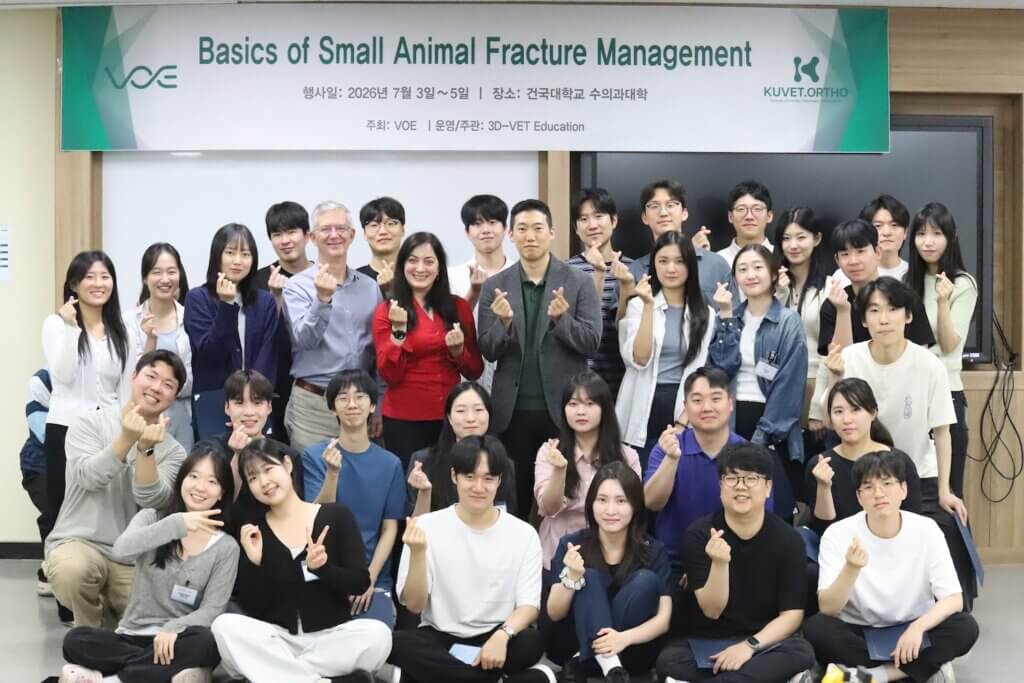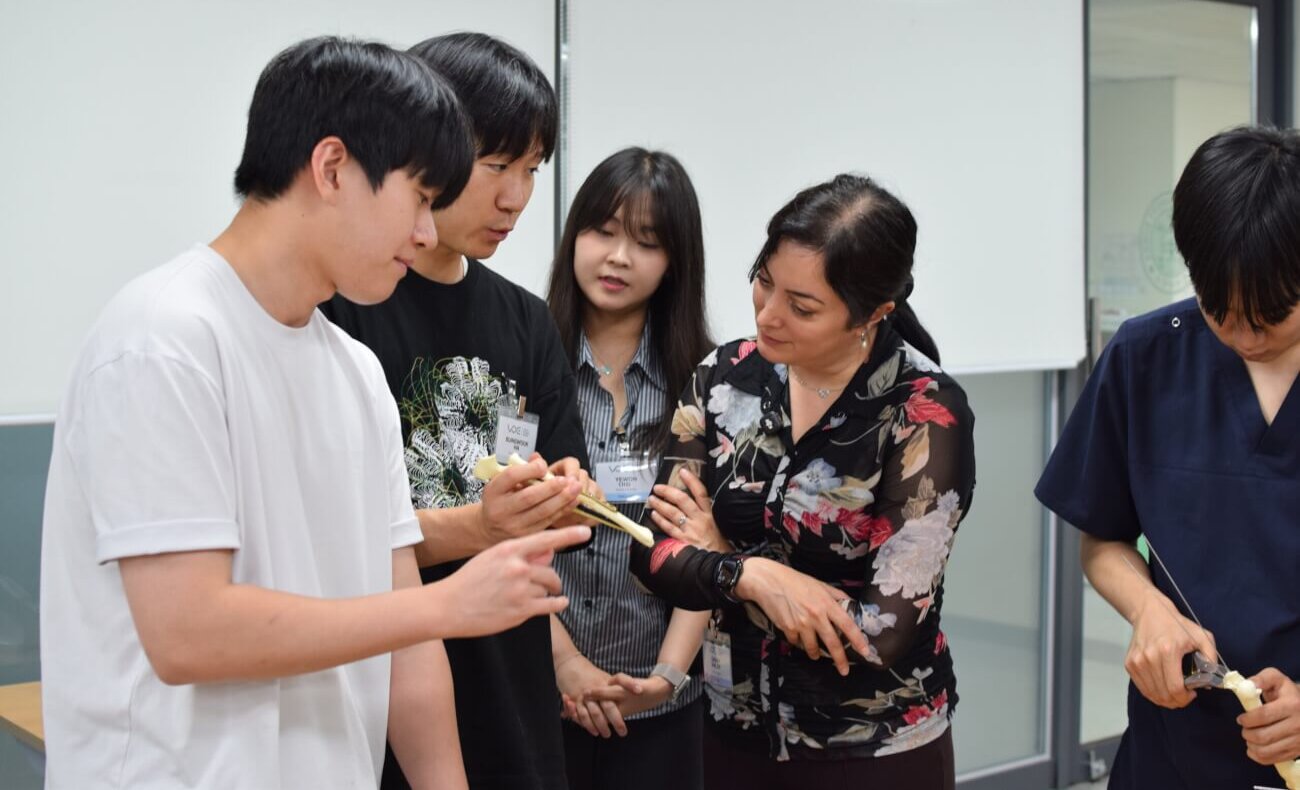
There is a particular kind of energy that fills a room when veterinarians separated by an ocean and a language discover they speak the same language after all — the language of orthopedic surgery: a well-reduced fracture, a perfectly placed screw, a case that keeps them up at night wondering if they did right by their patient. That energy filled a classroom in South Korea earlier this month when Dr. Sarah Malek, associate professor of small animal orthopedic surgery at the Purdue University College of Veterinary Medicine, and her surgery colleague in the Department of Veterinary Clinical Sciences, Dr. Mark Rochat, delivered the first Veterinary Orthopedic Essentials (VOE) course to 24 South Korean veterinarians.
For Dr. Malek, who is board-certified by the American College of Veterinary Surgeons (ACVS) and has spent more than a decade training veterinary students, interns, and residents at Purdue, the course is the latest chapter in a career built around the conviction that continuing education (CE) is how mentors in the profession pay it forward.
“I had the pleasure of learning from the very best during my years of training in Canada and the United States,” Dr. Malek said. “I find continuing education as a means of giving back to my profession.”
A Friendship That Became a Proposal

The idea for VOE began not with a curriculum, but with a friendship. Three years ago, Dr. Mu-Young Kim spent time at Purdue as a visiting scholar, forming a professional bond with Dr. Malek that outlasted his time on campus. Dr. Kim has since built his own career as a professor of veterinary orthopedic surgery as faculty at the Konkuk University College of Veterinary Medicine in Seoul, a vantage point from which he began to notice a gap in his home country’s CE landscape.
According to Dr. Malek, South Korea currently has access to only one globally recognized, structured program for principles of fracture management in dogs and cats, offered annually through the AO Foundation and taught by ACVS-trained surgeons and instructors. It is a well-regarded course, but Dr. Malek says a single annual offering cannot keep pace with domestic demand, and many South Korean veterinarians, have taken to traveling abroad simply to access the kind of hands-on orthopedic training readily available in North America and Europe.
That gap is what prompted Dr. Kim to reach out to Dr. Malek with a request that she build a training program for his colleagues in South Korea. She didn’t hesitate for long. “I was very excited about the idea,” Dr. Malek said, “and with my experience as an instructor in these courses in the past, I agreed to create a pilot course with the idea of establishing it for future expansion as a permanent CE program.”
Designing a Pilot with an Eye Toward Permanence
Dr. Malek envisioned a program that could eventually run on a recurring basis in South Korea with its own dedicated instructors. Over the course of a year, she and Dr. Kim worked out the details of the pilot course, utilizing a three-day format for 24 participants and combining lectures on fracture repair principles with dry labs where attendees practiced on bone models using real bone plates and implants.
To help with the teaching load, Dr. Malek recruited Dr. Rochat, professor of small animal orthopedic surgery, as co-instructor. A fellow board-certified surgeon with extensive experience both in the operating room and the classroom, Dr. Rochat rounded out the instructional team, which Dr. Malek described as essential to the pilot program’s success. Meanwhile, Dr. Kim and his team in South Korea handled the logistics on the ground — securing sponsors, compiling lists of needed supplies, and managing the myriad details required to bring a new course to life.
Three Days in July
Dr. Malek and Dr. Rochat then traveled to South Korea in late June in preparation for the course, which was held from July 3–5 with all 24 registered participants in attendance.
Interestingly, organizers had anticipated one challenge in particular: the course was conducted entirely in English. So, arrangements were made for two translators to be on hand. As it turned out, they only were needed occasionally. “The enthusiasm surpassed any cultural or language barriers,” Dr. Malek said. She described how, during breaks, participants pulled up their own cases and traded stories with the visiting instructors, reflecting the informal camaraderie of surgeons who enjoyed comparing notes regardless of what language they’d started the day in.
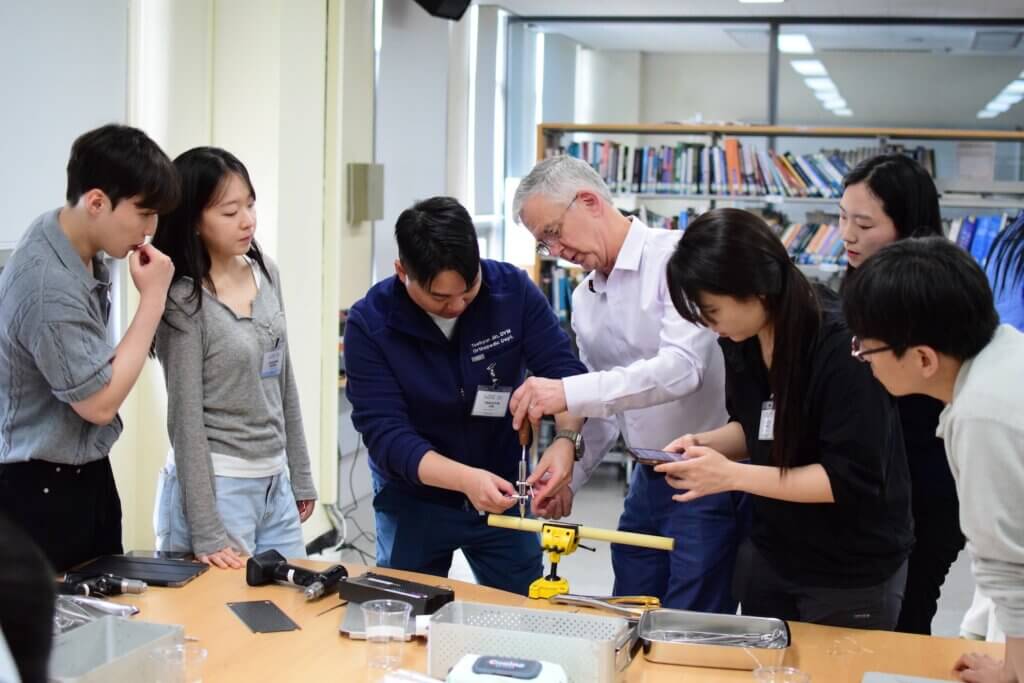
Pre- and post-course surveys backed up that impression with data, as participants reported significant gains in both knowledge of and confidence in the course material by the end of the three days, with the overwhelming majority sharing that the course had delivered what they had hoped to gain from it.
A Strategic Investment in Global Collaboration
For Dr. Malek, the significance of VOE extends well beyond the classroom in South Korea. She points to it as an example of what a college of veterinary medicine can accomplish as it supports the faculty’s ability in teaching, networking and building relationships internationally.
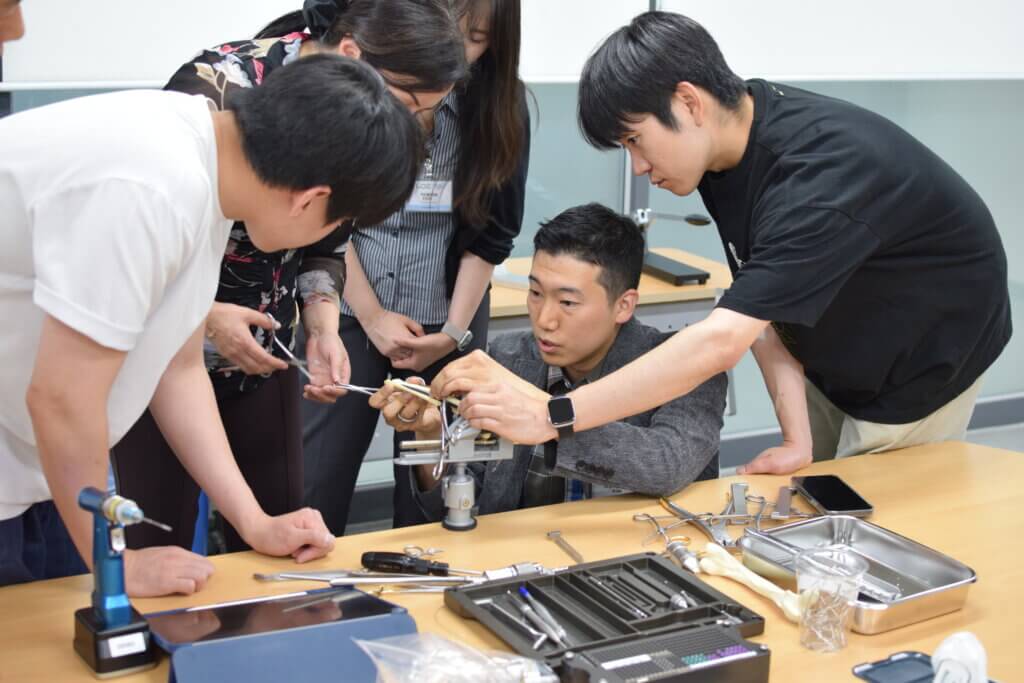
“I feel proud that as a faculty member at Purdue, I have been in a position that has allowed me to flourish as an instructor, establish connections, and dedicate time to create a CE program that aligns with our college’s priorities related to collegiality and collaboration, with a focus on education and engagement,” Dr. Malek said.
That investment enhances how Purdue is perceived internationally, Dr. Malek explains. “Purdue Veterinary Medicine once was known to Dr. Kim only because of his time spent at the college as a visiting scholar. Now the college is well-recognized by two dozen South Korean veterinarians – and, by extension, their professional networks – as a source of rigorous, hands-on orthopedic education.”
Organizers already are discussing what might come next for VOE, including future course offerings and the possibility of establishing a permanent instructor roster in South Korea. For now, the inaugural course stands as evidence of what a long-standing friendship, coupled with a year of planning, and a shared commitment to teaching can produce – with a room full of bone models, real implants, and veterinarians from two very different parts of the world who came together to learn something in common and be better prepared for their next orthopedic case.