
Purdue Veterinary Medicine Becomes Purdue’s First Engaged College!

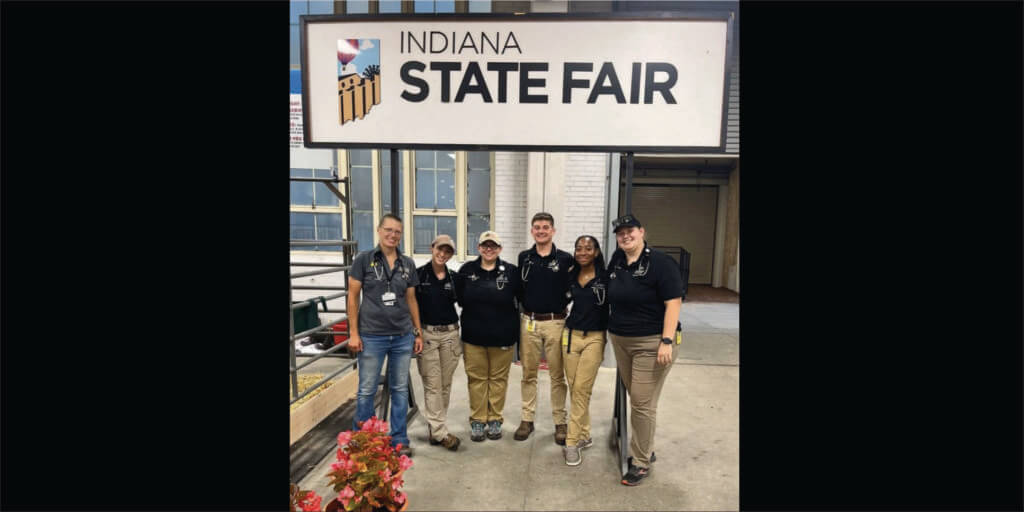
Purdue veterinary medicine partners with the Indiana State Fair to provide veterinary care for the fair’s exhibition animals, coordinating all the veterinary services for the exhibition animals on the fairgrounds.
Purdue Veterinary Medicine partners with the Indiana State Fair to provide veterinary care for the fair’s exhibition animals, coordinating all the veterinary services for the exhibition animals on the fairgrounds.

The Purdue University College of Veterinary Medicine is participating in the University’s Engaged College Program (ECP), which is a new initiative developed by Purdue’s Office of Engagement to support colleges with the resources to focus on building, sustaining, assessing, bringing awareness to, and rewarding quality community engagement activities. Last Friday, August 23, it was announced that the College of Veterinary Medicine is the FIRST college to complete the Engaged College Program self-assessment and action plan!

This accomplishment reflects the work of the PVM task force, which, with input from others, self-assessed the college across 25 items and five dimensions. Purdue Veterinary Medicine’s three-year action plan focuses on two goals:

  • Increasing faculty, staff, and student awareness of Purdue’s definition of engagement and college engagement programs and opportunities.
  • Developing and implementing a standardized system for tracking, collecting metrics, and celebrating community engagement activities of faculty, staff and students.

“This process enabled us to take stock of all of the diverse engagement initiatives we have launched with communities across the globe,” said Dr. S. Kathleen Salisbury, interim dean of the college and associate dean for academic affairs. “As a result, we are inspired to expand awareness of all that we are accomplishing through these mutually beneficial collaborations that positively impact animal and public health.”

Many thanks to the task force members for their hard work in making this happen!

  • Sandy San Miguel, Associate Dean for Engagement and Professor, — Task Force Chair
  • Candace Croney, Associate Vice Provost for Diversity, Inclusion and Belonging, Director for Center for Animal Welfare Science, and Professor
  • Kenitra Hendrix, Animal Disease Diagnostic Laboratory Director and Clinical Associate Professor
  • Geoff Lossie, Director of Veterinary Extension and Clinical Assistant Professor
  • Ellen Lowery, Associate Dean for Hospital Operations, Chief Veterinary Officer, and Clinical Professor
  • Leanne Nieforth, Assistant Professor of the Human Animal Bond
  • Erin Phillips, Principal, Thomas Miller Elementary School
  • Malathi Raghavan, Director for Outcomes Assessment and Data Management and Clinical Associate Professor
  • Darryl Ragland, Section Head of Production Medicine and Professor
  • Ramon Roberts, DVM Student, Class of 2027
  • Addison Sheldon, Director for Global Engagement
  • Christina Wilson-Frank, Toxicology Section Head, Animal Disease Diagnostic Laboratory, and Clinical Professor

Click here to read more about Purdue University’s Engaged College Program.

Writer(s): Kevin Doerr, Dr. Sandra San Miguel | pvmnews@purdue.edu

Recent Stories

“Paws Up” for Jennifer Danaher – brought to you by the PVM Wellness Committee

This week we express our gratitude to Jennifer Danaher, who is department secretary for Veterinary Clinical Sciences.

‘Purdue Pursuits’: A PVM angle on Purdue’s teaching and learning reading groups

Crafting meaningful and engaging course experiences has been at the top of Dielson Vieira’s mind ever since he joined the Purdue University College of Veterinary Medicine’s faculty in 2024. As a clinical assistant professor in the Department of Basic Medical Sciences, Vieira is already adept at applying innovative teaching practices to classroom environments, but that doesn’t stop him from seeking out new ideas, approaches and perspectives — insights he gains through outlets like Purdue’s teaching and learning reading groups.

Top tier biology journal publishes PVM study that unlocks secrets of a drug-resistant fungal pathogen, which causes serious infections in humans

Though the name “Candida auris” is far from a household term, public health experts know it well because the multi-drug-resistant fungal pathogen, which causes serious human infections, has been classified as an urgent threat by the U.S. Centers for Disease Control and Prevention (CDC) Antibiotic Threats Report (2019). Dr. Shankar Thangamani, Associate Professor of Microbiology and University Faculty Scholar in the Purdue University College of Veterinary Medicine’s Department of Comparative Pathobiology, is researching C. auris, aided by a 2.4 million grant from the National Institutes of Health (NIH). New research findings, just published in Nature Microbiology, show how C. auris adapts and evades the immune system.

In Print: ‘Translational Research Methods for Tauopathies’

A just-published 300-page volume edited by Jessica Fortin, Purdue assistant professor in the College of Veterinary Medicine’s Department of Basic Medical Sciences, provides a significant new resource for researchers studying a group of neurodegenerative diseases known as tauopathies. “Translational Research Methods for Tauopathies” provides detailed protocols intentionally selected to serve as a basis for research laboratories seeking to further treatments for such debilitating neurodegenerative diseases as Alzheimer’s and chronic traumatic encephalopathy (CTE).

It’s Almost Here!

Though the annual Purdue Veterinary Conference is almost upon us, there’s still time to register and take advantage of this time-honored College of Veterinary Medicine fall tradition that combines excellent continuing education with fun opportunities for reconnecting with colleagues and classmates, networking, and learning about the latest veterinary trends and products. The 2026 Purdue Veterinary Conference takes place September 23–26 on the Purdue University campus. The annual event has something for everyone, from veterinarians to veterinary technicians, faculty, staff and students.