
Purdue Veterinary Hospital Welcomes Mask Donation from the Greater Lafayette Chinese Community

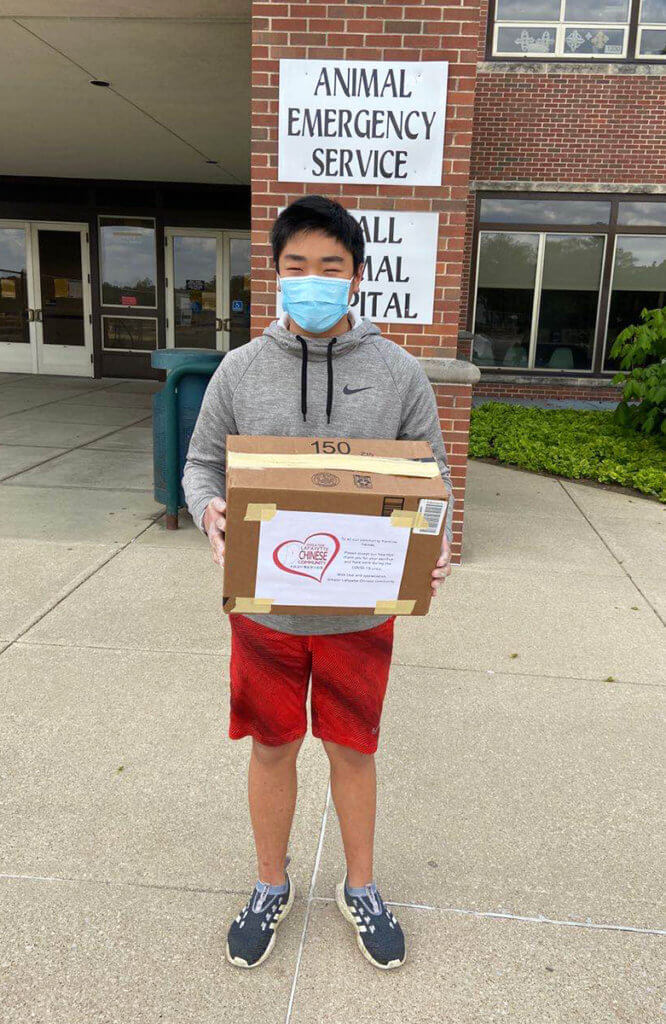
A boy wearing a facemask holds a box in front of the Small Animal Hospital
Ninth-grader Johnny Shen holds a box of facemasks donated to the Purdue Veterinary Hospital by the Greater Lafayette Chinese Community.

Community support continues to pour in for the Purdue Veterinary Hospital in the form of facemask donations for hospital employees. In addition to individual donations, the hospital received a bulk donation from the Greater Lafayette Chinese Community Thursday, May 7.

Johnny Shen, a ninth-grader, accompanied by his mom, Linda Mao, delivered the donation of 350 facemasks to Lynn Hall. Hospital Administrative Assistant Terri Donald was on-hand to accept the donation. In a note of thanks to the GLCC, Terri wrote, “Your show of community support will encourage the veterinary hospital team of clinicians, nurses, staff, interns, residents, and students. Again, thank you very much!”

Shaomin Hu, a representative of the GLCC and point-person for the donation, said their donors were really pleased with every effort by the healthcare team in the Purdue Veterinary Hospital to go through this crisis, adding that the community will continue to make their best effort to help in this fight. The GLCC recently was featured in a story on WLFI for their generous support to 19 local healthcare facilities and front-line organizations by providing PPE and lunch boxes. Click here to view the GLCC Facebook page.
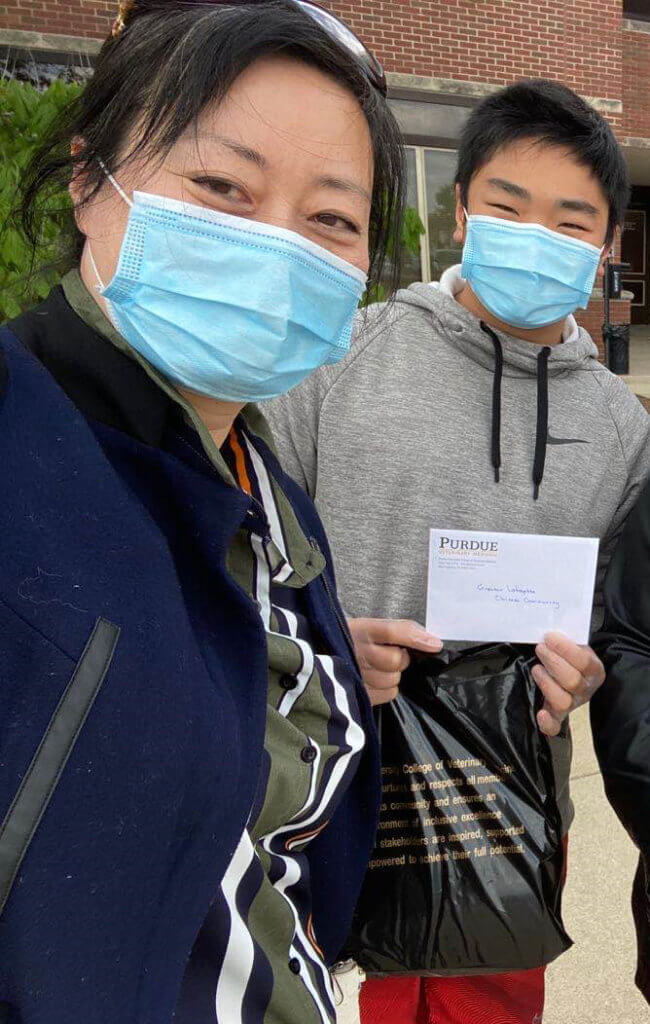
Johnny holds up an envelope as his mom snaps a photo of them
Johnny, accompanied by his mom, Linda Mao, holds up a thank you card they received from the hospital administration in appreciation for the generous donation.

In response to the Centers for Disease Control and Prevention safety guidelines on the use of cloth face coverings to help slow the spread of COVID-19, Dr. Ellen I. Lowery, Purdue Veterinary Hospital director, had issued a request to the PVM family seeking donations of cloth facemasks to use in the hospital. The facemasks are not a replacement for appropriate PPE or surgical masks. However, in situations where physical distancing of six feet is not always possible, such as with patient care, the use of cloth masks helps protect individuals around the mask wearer. As the COVID-19 pandemic continues, the hospital remains committed to the health and safety of the hospital team and clients.

Facemask donations are still being accepted. Faculty, staff, and students who are working on campus can find donation bins in Lynn Hall near the hospital reception areas, loading dock, Continuum Café area, and the hospital administration office. Additionally, pink drop-off bins are located near the client parking areas outside both the Small and Large Animal Hospitals.

Writer(s): Allison Carey | pvmnews@purdue.edu

Recent Stories

“Paws Up” for Jennifer Danaher – brought to you by the PVM Wellness Committee

This week we express our gratitude to Jennifer Danaher, who is department secretary for Veterinary Clinical Sciences.

‘Purdue Pursuits’: A PVM angle on Purdue’s teaching and learning reading groups

Crafting meaningful and engaging course experiences has been at the top of Dielson Vieira’s mind ever since he joined the Purdue University College of Veterinary Medicine’s faculty in 2024. As a clinical assistant professor in the Department of Basic Medical Sciences, Vieira is already adept at applying innovative teaching practices to classroom environments, but that doesn’t stop him from seeking out new ideas, approaches and perspectives — insights he gains through outlets like Purdue’s teaching and learning reading groups.

Top tier biology journal publishes PVM study that unlocks secrets of a drug-resistant fungal pathogen, which causes serious infections in humans

Though the name “Candida auris” is far from a household term, public health experts know it well because the multi-drug-resistant fungal pathogen, which causes serious human infections, has been classified as an urgent threat by the U.S. Centers for Disease Control and Prevention (CDC) Antibiotic Threats Report (2019). Dr. Shankar Thangamani, Associate Professor of Microbiology and University Faculty Scholar in the Purdue University College of Veterinary Medicine’s Department of Comparative Pathobiology, is researching C. auris, aided by a 2.4 million grant from the National Institutes of Health (NIH). New research findings, just published in Nature Microbiology, show how C. auris adapts and evades the immune system.

In Print: ‘Translational Research Methods for Tauopathies’

A just-published 300-page volume edited by Jessica Fortin, Purdue assistant professor in the College of Veterinary Medicine’s Department of Basic Medical Sciences, provides a significant new resource for researchers studying a group of neurodegenerative diseases known as tauopathies. “Translational Research Methods for Tauopathies” provides detailed protocols intentionally selected to serve as a basis for research laboratories seeking to further treatments for such debilitating neurodegenerative diseases as Alzheimer’s and chronic traumatic encephalopathy (CTE).

It’s Almost Here!

Though the annual Purdue Veterinary Conference is almost upon us, there’s still time to register and take advantage of this time-honored College of Veterinary Medicine fall tradition that combines excellent continuing education with fun opportunities for reconnecting with colleagues and classmates, networking, and learning about the latest veterinary trends and products. The 2026 Purdue Veterinary Conference takes place September 23–26 on the Purdue University campus. The annual event has something for everyone, from veterinarians to veterinary technicians, faculty, staff and students.