
Former BMS Professor and GeniPhys Founder Sees Continued Success in Development of Wound Management Product

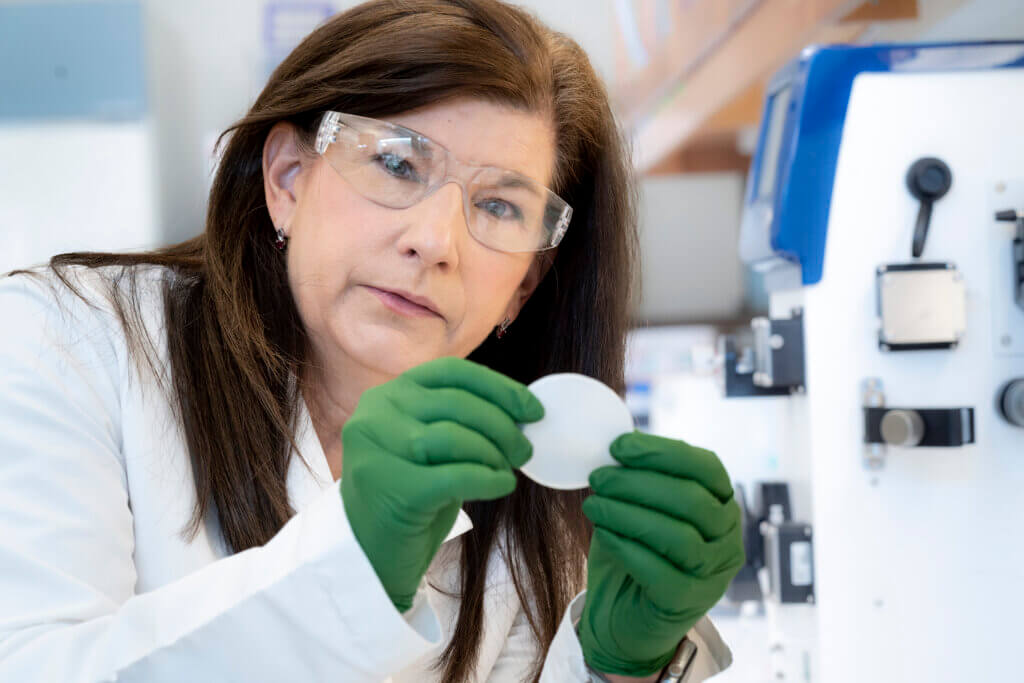
Sherry Harbin, founder and chief technology officer of GeniPhys and Purdue University researcher with ties to the College of Veterinary Medicine’s Basic Medical Sciences Department and the Weldon School of Biomedical Engineering, shows a high-strength collagen sheet fabricated from the proprietary collagen polymer technology that GeniPhys is commercializing. (Purdue Research Foundation photo/Vincent Walter)

GeniPhys, a preclinical-stage company founded by a Purdue University researcher with ties to the College of Veterinary Medicine, is expected to commercialize a wound management product in the second quarter of 2025 that involves developing regenerative collagen polymeric biomaterials for soft tissue restoration.  The company has been awarded a $500,000 National Science Foundation (NSF) Small Business Innovation Research (SBIR) Phase IIB supplemental funding grant to support regulatory and commercial readiness of its flagship product, Collymer Self-Assembling Scaffold (SAS). The Phase IIB grant supplements a nearly $1 million NSF SBIR Phase II grant awarded to GeniPhys in 2022 and will support completion of manufacturing scalability and necessary testing to achieve 510(k) clearance of Collymer SAS for the wound care market.

“Hard-to-heal soft tissue defects and voids due to injury, disease, congenital birth defects or tumor removal are a major burden to both patients and the health care system,” said Andy Eibling, GeniPhys CEO. “GeniPhys is answering a longtime need for novel options for rapid and effective soft tissue restoration. This grant helps bring us into the homestretch of offering patients the potential of a more cost-effective treatment with more predictable outcomes and shorter healing times.”

Collymer SAS was developed by Sherry Harbin, a Purdue professor of biomedical engineering and former professor (now professor by courtesy appointment) in the College of Veterinary Medicine’s Department of Basic Medical Sciences.  Harbin founded GeniPhys and serves as the company’s chief technology officer. The patented technology is licensed to GeniPhys by the Purdue Innovates Office of Technology Commercialization and is the cornerstone of the company’s broad intellectual property portfolio. Harbin also is part of Purdue’s collaborative One Health initiative.

Collymer SAS is a novel flowable collagen biomaterial based on a validated and proprietary technology platform that immediately restores tissue continuity via a rapid-forming, self-assembling collagen scaffold. Unlike traditional implantable materials, this collagen scaffold promotes regenerative remodeling — facilitating integration, cellularization and restoration of tissue characteristics without causing an inflammatory response. Its structural and signaling characteristics replicate those of natural collagen for faster healing and restoration of tissue defects and voids affecting soft tissues such as skin, breast, skeletal muscle and adipose.

While Collymer SAS has a wide range of applications across various surgical specialties, GeniPhys will initially enter the advanced wound care market, where more than 10 million patients are affected with nonhealing, chronic wounds. Simultaneously, GeniPhys will pursue additional indications, including breast-conserving surgery (lumpectomy) where preclinical study results have shown Collymer SAS excels as a first-in-kind regenerative breast tissue filler with potential to improve both oncologic and cosmetic outcomes.

Click here to view a complete news release with more information about GeniPhys and the Purdue Innovates Office of Technology Commercialization

Writer(s): Steve Martin | pvmnews@purdue.edu

Recent Stories

“Paws Up” for Jennifer Danaher – brought to you by the PVM Wellness Committee

This week we express our gratitude to Jennifer Danaher, who is department secretary for Veterinary Clinical Sciences.

‘Purdue Pursuits’: A PVM angle on Purdue’s teaching and learning reading groups

Crafting meaningful and engaging course experiences has been at the top of Dielson Vieira’s mind ever since he joined the Purdue University College of Veterinary Medicine’s faculty in 2024. As a clinical assistant professor in the Department of Basic Medical Sciences, Vieira is already adept at applying innovative teaching practices to classroom environments, but that doesn’t stop him from seeking out new ideas, approaches and perspectives — insights he gains through outlets like Purdue’s teaching and learning reading groups.

Top tier biology journal publishes PVM study that unlocks secrets of a drug-resistant fungal pathogen, which causes serious infections in humans

Though the name “Candida auris” is far from a household term, public health experts know it well because the multi-drug-resistant fungal pathogen, which causes serious human infections, has been classified as an urgent threat by the U.S. Centers for Disease Control and Prevention (CDC) Antibiotic Threats Report (2019). Dr. Shankar Thangamani, Associate Professor of Microbiology and University Faculty Scholar in the Purdue University College of Veterinary Medicine’s Department of Comparative Pathobiology, is researching C. auris, aided by a 2.4 million grant from the National Institutes of Health (NIH). New research findings, just published in Nature Microbiology, show how C. auris adapts and evades the immune system.

In Print: ‘Translational Research Methods for Tauopathies’

A just-published 300-page volume edited by Jessica Fortin, Purdue assistant professor in the College of Veterinary Medicine’s Department of Basic Medical Sciences, provides a significant new resource for researchers studying a group of neurodegenerative diseases known as tauopathies. “Translational Research Methods for Tauopathies” provides detailed protocols intentionally selected to serve as a basis for research laboratories seeking to further treatments for such debilitating neurodegenerative diseases as Alzheimer’s and chronic traumatic encephalopathy (CTE).

It’s Almost Here!

Though the annual Purdue Veterinary Conference is almost upon us, there’s still time to register and take advantage of this time-honored College of Veterinary Medicine fall tradition that combines excellent continuing education with fun opportunities for reconnecting with colleagues and classmates, networking, and learning about the latest veterinary trends and products. The 2026 Purdue Veterinary Conference takes place September 23–26 on the Purdue University campus. The annual event has something for everyone, from veterinarians to veterinary technicians, faculty, staff and students.