
BMS Scholar J. Paul Robinson Among Six Purdue Innovators to Receive Trask Innovation Funding

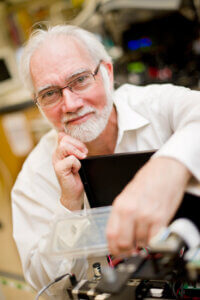
A portrait of an older man with glasses, smiling while interacting with electronic equipment in a laboratory setting.

Dr. J. Paul Robinson, the SVM Professor of Cytomics in the College of Veterinary Medicine’s Department of Basic Medical Sciences, is one of six Purdue University researchers receiving a total of nearly $209,000 from the Trask Innovation Fund to help their labs commercialize their innovations.  The fund is a development program established to support projects that advance the commercial value of Purdue intellectual property.

Dr. Robinson holds a joint appointment in the College of Veterinary Medicine and the Weldon School of Biomedical Engineering.  He is receiving Trask funding for a handheld device for real-time detection of pathogens, toxins, and contaminating chemicals for biodefense and food analysis.

The Trask Innovation Fund makes awards twice a year to aid faculty and staff with their patented innovations that are being commercialized through the Purdue Research Foundation Office of Technology Commercialization (OTC), which is housed in the Convergence Center in the Discovery Park District.  There are three Trask Innovation Fund tracks: Innovation Sparks for Life Science, Innovation Sparks for Physical Sciences, and Commercialization Partner Spark.  Dr. Robinson is receiving support through the physical sciences track. 

The other five Purdue researchers receiving funding this round are:

  • Dr. Jean Chmielewski, Alice Watson Kramer Distinguished Professor of Chemistry (track: life science)
  • Dr. Arun Bhunia, professor of food science (track: life science)
  • Dr. Luna Lu, ACPA Professor of Civil Engineering (track: commercialization)
  • Dr. Pedro Irazoqui, Reilly Professor of Biomedical Engineering and professor of electrical and computer engineering (track: commercialization)
  • Dr. Jeffrey Youngblood, professor of materials engineering (track: physical sciences)

Click here to view a news release with further details about the other funded innovations.

“Even during a global pandemic, researchers created many technologies worthy of OTC’s investment to develop solutions through the Purdue commercialization ecosystem and Purdue’s growing Discovery Park District,” said Abhijit Karve, director of business development for OTC.  Purdue inventors who are prepared to move their innovations to market have until February 19 to apply for funding through the Trask Innovation Fund.

All Purdue faculty, staff, and researchers who have submitted a disclosure to OTC are eligible to submit proposals.  To learn more about these and other Purdue technologies, contact OTC. The Purdue Research Foundation Office of Technology Commercialization operates one of the most comprehensive technology transfer programs among leading research universities in the U.S. Services provided by the office support the economic development initiatives of Purdue University and benefit the university’s academic activities through commercializing, licensing, and protecting Purdue intellectual property.

Writer(s): Chris Adam, Purdue News Service | pvmnews@purdue.edu

Recent Stories

“Paws Up” for Jennifer Danaher – brought to you by the PVM Wellness Committee

This week we express our gratitude to Jennifer Danaher, who is department secretary for Veterinary Clinical Sciences.

‘Purdue Pursuits’: A PVM angle on Purdue’s teaching and learning reading groups

Crafting meaningful and engaging course experiences has been at the top of Dielson Vieira’s mind ever since he joined the Purdue University College of Veterinary Medicine’s faculty in 2024. As a clinical assistant professor in the Department of Basic Medical Sciences, Vieira is already adept at applying innovative teaching practices to classroom environments, but that doesn’t stop him from seeking out new ideas, approaches and perspectives — insights he gains through outlets like Purdue’s teaching and learning reading groups.

Top tier biology journal publishes PVM study that unlocks secrets of a drug-resistant fungal pathogen, which causes serious infections in humans

Though the name “Candida auris” is far from a household term, public health experts know it well because the multi-drug-resistant fungal pathogen, which causes serious human infections, has been classified as an urgent threat by the U.S. Centers for Disease Control and Prevention (CDC) Antibiotic Threats Report (2019). Dr. Shankar Thangamani, Associate Professor of Microbiology and University Faculty Scholar in the Purdue University College of Veterinary Medicine’s Department of Comparative Pathobiology, is researching C. auris, aided by a 2.4 million grant from the National Institutes of Health (NIH). New research findings, just published in Nature Microbiology, show how C. auris adapts and evades the immune system.

In Print: ‘Translational Research Methods for Tauopathies’

A just-published 300-page volume edited by Jessica Fortin, Purdue assistant professor in the College of Veterinary Medicine’s Department of Basic Medical Sciences, provides a significant new resource for researchers studying a group of neurodegenerative diseases known as tauopathies. “Translational Research Methods for Tauopathies” provides detailed protocols intentionally selected to serve as a basis for research laboratories seeking to further treatments for such debilitating neurodegenerative diseases as Alzheimer’s and chronic traumatic encephalopathy (CTE).

It’s Almost Here!

Though the annual Purdue Veterinary Conference is almost upon us, there’s still time to register and take advantage of this time-honored College of Veterinary Medicine fall tradition that combines excellent continuing education with fun opportunities for reconnecting with colleagues and classmates, networking, and learning about the latest veterinary trends and products. The 2026 Purdue Veterinary Conference takes place September 23–26 on the Purdue University campus. The annual event has something for everyone, from veterinarians to veterinary technicians, faculty, staff and students.