
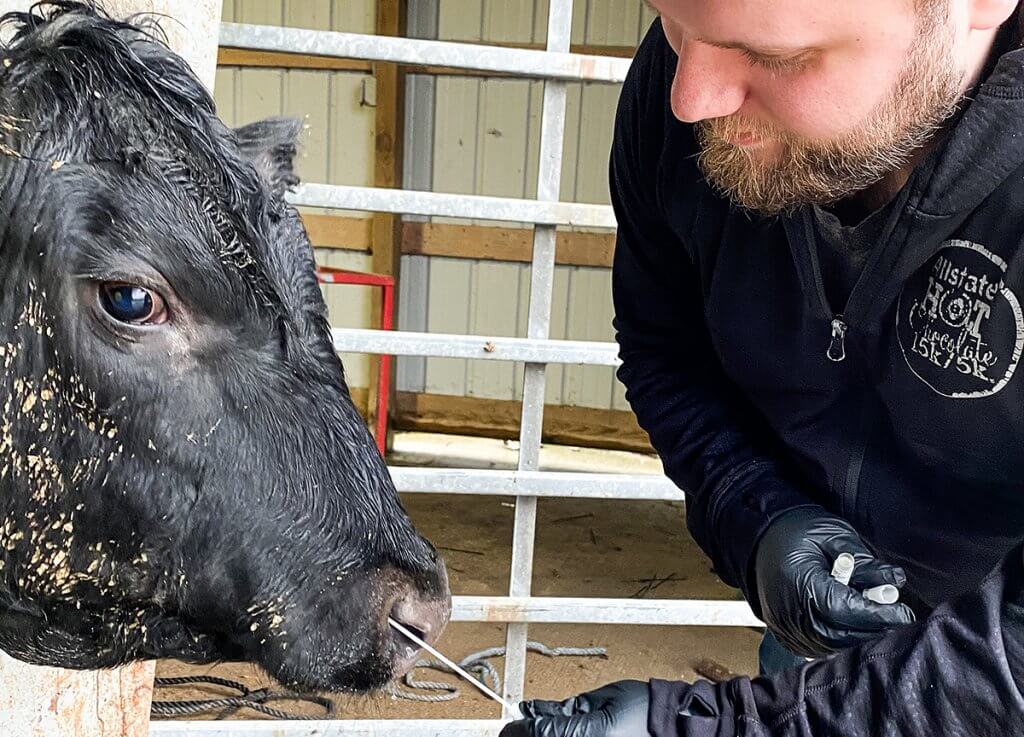
Bovine respiratory disease (BRD), one of the most prevalent and costly illnesses in the beef and dairy industries, accounts for about half of all feedlot deaths in North America and costs producers as much as $900 million a year. Quickly diagnosing the illness could improve the well-being of animals and save producers significant money. Current tests don’t offer results for four or more days.
Purdue University researchers, including faculty from the College of Veterinary Medicine, are developing technology to reduce diagnosis time to about 30 minutes. Led by Dr. Mohit Verma, assistant professor of agricultural and biological engineering, their work is being funded by a $1 million U.S. Department of Agriculture National Institute of Food and Agriculture Inter-Disciplinary Engagement in Animal Systems (IDEAS) grant.
“Bovine respiratory disease can be triggered by a number of bacteria and viruses, making treatment decisions difficult. By the time a test comes back in four or five days, the disease may have killed the calf or spread to many others in the feedlot,” Dr. Verma said. “Over the next three years, we will develop a test that addresses the bacterial side and have a prototype to use in the field.”

Dr. Jennifer Koziol, clinical assistant professor in the College of Veterinary Medicine’s Department of Veterinary Clinical Sciences, is a co-investigator on the project. She said veterinarians currently treat BRD with antibiotics that are effective against the most common bacteria that causes the disease. But it’s possible the bacteria is resistant to the chosen antibiotic, making treatment ineffective. Expediting quick and accurate diagnoses while aiding in choosing the correct antibiotic the first time can save calf lives and reduce unnecessary antibiotic usage.
“When we have BRD going through multiple animals in the herd, we need to know exactly what bacteria we are up against and exactly which antibiotics will be useful quicker than four to five days so we can make good choices about the antibiotics we use the first time,” Dr. Koziol explained. “Having a rapid test that we can use is good for the animals and good for antibiotic stewardship.”
Dr. Verma learned about the need for better BRD testing from Aaron Ault, a senior research engineer in Purdue’s School of Electrical and Computer Engineering, who farms 3,200 acres of corn and soybeans and manages 3,000 head of cattle near Rochester, Ind. Ault, who will work with the team on engineering components of the technology, said he may spend weeks pulling two or three dozen sick calves per day from his herd for treatment during a bad BRD outbreak.
“The No. 1 struggle I have in farming is BRD. I believe it’s the biggest problem in the beef industry,” Ault said. “This technology can change that. But there’s also an opportunity to collect much better data about the health of our cattle through machine learning, looking at the types and amounts of bacteria normally present in a calf’s respiratory system and using that information to predict potential issues down the road.”
Dr. Verma believes the biosensor technology his team is developing for BRD could be the base technology for detecting other animal and human illnesses. Prior to receiving the USDA-NIFA IDEAS grant, Dr. Verma had started adapting the platform to identify the presence of SARS-CoV-2, the virus that causes COVID-19.

“To accurately diagnose a BRD infection, our sensors will need to be versatile enough to identify many bacteria and viruses,” Dr. Verma said. “It’s entirely possible we’ll be able to adapt these sensors rapidly to address other health issues, potentially even new viruses that require quick detection to prevent global pandemics.”

In addition to Dr. Verma, Dr. Koziol and Aaron Ault, the research team includes Dr. Candace Croney, who holds a joint appointment in the College of Veterinary Medicine’s Department of Comparative Pathobiology and the College of Agriculture’s Department of Animal Sciences; Dr. Deepti Pillai, clinical assistant professor of diagnostic microbiology in the Department of Comparative Pathobiology; Dr. Jacquelyn Boerman, Dr. Timothy Johnson and Dr. Jon Schoonmaker of the Department of Animal Sciences; and Dr. Hwanseok Song from Purdue’s Brian Lamb School of Communication.
The preliminary research Dr. Verma’s team conducted to obtain the $1 million USDA-NIFA grant was funded by a startup Agricultural Science and Extension for Economic Development (AgSEED) grant. AgSEED was established through Crossroads funding from the Indiana legislature to foster the state’s leadership in plant and animal agriculture and rural growth. Dr. Verma also received funding from the PI4D Indiana Disease Diagnostics Challenge.
