
BMS Faculty Member Finds that Urine Analysis Could Speed Diagnosis of Traumatic Brain Injury

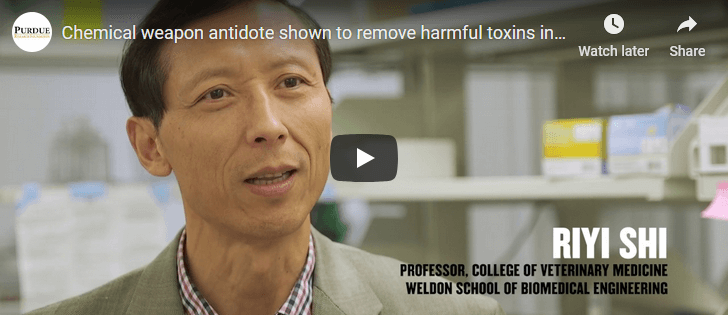
video thumbnail of youtube video of dr. shi
Purdue Veterinary Medicine Professor Riyi Shi, who holds a joint appointment in the Department of Basic Medical Sciences and the Weldon School of Biomedical Engineering, led a research team to discover a new, noninvasive procedure to quickly identify brain trauma and expedite treatment.

A team of scientists led by Dr. Riyi Shi, Purdue Veterinary Medicine professor of basic medical sciences, has conducted research indicating that soldiers and athletes could have improved outcomes from traumatic brain injury through faster diagnosis using urine analysis.  The researchers also report that early detection and treatment can help in cases involving even a mild hit or blast to the brain.

A traumatic brain injury is often easily suspected and can be confirmed and treated if necessary following an injury using a blood analysis.  But the research by Dr. Shi’s team found that even one mild blast to the brain can cause very subtle but permanent damage, and urine analysis taken within one week of a mild to traumatic brain injury can provide faster diagnosis and treatment for such injuries.

“We’re finding that even a mild blast can cause long-term, life-changing health issues,” said Dr. Shi. “The individual appears to be fine, and it’s difficult to tell if you just look at a person. But the fact is that these types of hits are multiplied over years and often ignored until someone reaches an age when other factors come into play. Identifying and treating these incidents sooner can help mitigate issues later in life.”

The study led by Dr. Shi reports that checking the urine within seven days following such an injury, even a mild injury with no immediately obvious symptoms, could be less invasive, faster, and help reduce the risk of long-term health issues including Parkinson’s disease.  “Even at one day post-injury, a simple urine analysis can reveal elevations in the neurotoxin acrolein. The presence of this ‘biomarker’ alerts us to the injury, creating an opportunity for intervention,” said Dr. Shi, who holds a joint appointment in Purdue’s College of Veterinary Medicine and Weldon School of Biomedical Engineering. “This early detection and subsequent treatment window could offer tremendous benefits for long-term patient neurological health.”

The research paper, titled “Acrolein-mediated Alpha-synuclein Pathology Involvement in the Early Post-injury Pathogenesis of Mild Blast-induced Parkinsonian Neurodegeneration,” was published in July in the Journal of Molecular and Cellular Neuroscience.

“Most people have heard that traumatic brain injuries are linked to Parkinson’s, Alzheimer’s, and other neurodegenerative diseases, dating back as far as to Muhammad Ali and even earlier,” Dr. Shi said. “The seriousness of this relationship is readily apparent; however, we want to, for the first time, implement a mechanism or protocol capable of connecting brain injuries to these diseases. We can accomplish this by testing for acrolein, which is well-researched and already recognized as a very important pathological factor in Parkinson’s disease. This study establishes a solid link between the two and opens the door for faster treatments utilizing acrolein urine tests during the days following a traumatic episode.”

In the research study, a urine analysis tested for an increased elevation of acrolein or oxidative stress within one week following a neurological injury.  “What’s important is that urine tests can be performed much easier than blood tests, or other more invasive medical procedures currently available,” Dr. Shi said. “And it has been shown that individuals who experience brain injuries are three times more likely than their age-matched peers to develop neurological disease. If we can establish a protocol to routinely test urine following a traumatic brain injury, we can improve treatment options earlier and potentially offer better long-term outcomes.”

More than 500,000 people in the U.S. are currently living with Parkinson’s disease, and another 50,000 people are diagnosed with this neurodegenerative disorder every year, according to the National Institutes of Health.

Click here to view a video about the link between acrolein and Parkinson’s disease based on Dr. Shi’s research.

The research was funded in part by the National Institutes of Health, the Indiana State Department of Health, and the Indiana CTSI Collaboration in Biomedical Translational Research Pilot Program.

Dr. Shi’s work aligns with Purdue’s Giant Leaps celebration, acknowledging the University’s global advancements in health as part of Purdue’s 150th anniversary. This is one of the four themes of the yearlong celebration’s Ideas Festival, designed to showcase Purdue as an intellectual center solving real-world issues.

Click here to view a complete news release about the research.

Writer(s): Cynthia Sequin, PRF, and Kevin Doerr | pvmnews@purdue.edu

Recent Stories

Fourth Purdue AMR Conference Promotes Collaboration to Address Global Health Threat of Antimicrobial Resistance through PVM’s One Health Initiative. 

Purdue University served as the place where local, national and international experts came together in-person and online recently for concentrated sharing of research, expertise and insight targeting the threat of multi-drug-resistant infections. The fourth annual AMR Conference February 25-26, 2026, held in Stewart Center, attracted more than 100 attendees from across the U.S. and six other countries.

Presentation of Research Poster Prizes Wraps up Antimicrobial Resistance Conference 

Purdue University’s fourth Antimicrobial Resistance Conference concluded February 26 with remarks from Purdue Vice President for Health Affairs and Jeannie and Jim Chaney Dean of Pharmacy Eric Barker, PhD, who also announced the winners of the conference’s research poster session.  The poster contest, which attracted more than 20 entries, was divided into categories for undergraduate and graduate students.

“Paws Up” – brought to you by the PVM Wellness Committee

Today we are glad to highlight one of our own committee members. Charlene Evans, Toxicology Laboratory Supervisor in the Reed Animal Disease and Diagnostic Laboratory, is a wonderful champion for mental health and wellbeing on the PVM Wellness Committee and within the ADDL community.

Purdue Professor of Large Animal Surgery Named Veterinary Clinical Sciences Department Head

Dr. Timothy Lescun, a board-certified large animal surgeon, has been appointed head of the Department of Veterinary Clinical Sciences in the Purdue university College of Veterinary Medicine.

Purdue Veterinary Medicine Engages with Swine Health Leaders at AASV

The Purdue University College of Veterinary Medicine was well-represented at the 2026 American Association of Swine Veterinarians (AASV) Annual Meeting, which provided important continuing education and networking opportunities for swine practitioners. The conference in Las Vegas February 28 through March 3, 2026, also provided the opportunity for the college to engage with alumni and partners who are influencing the future of animal agriculture.

Boilers, Ballgowns, Boilermaker Pride and PVM!

With a fun twist on classic title, the 2026 Purdue Boilermaker Ball provided a meaningful evening of celebrating Purdue University’s distinguished heritage and traditions, and the Purdue University College of Veterinary Medicine was proud to be part of the event. Dubbed “A Midwinter Night’s Dream,” the festive function February 28 at the Indianapolis Marriott Downtown proved to be one enchanted evening! PVM alumni and donors were among the guests for the creative black-tie event, and enjoyed the opportunity to visit and share the common commitment to veterinary medicine, animal health, and the mission of the College of Veterinary Medicine.

Purdue Alumni Honored with IVMA Awards for Achievement, Volunteer Service and Contributions to Profession

The Indiana Veterinary Medical Association (IVMA) recognized several Purdue Veterinary Medicine alumni with awards and honors at the association’s 2026 Crossroads Veterinary Conference.  The annual meeting in Noblesville, Indiana, was held February 5-7 and featured scientific and practice management sessions for veterinary professionals as well as an exhibit hall. As part of the conference, the IVMA hosted its membership meeting February 5, when awards and honors were presented.

Keeping Your Pets Safe from Highly Pathogenic Avian Influenza (HPAI)

The Purdue Veterinary Hospital has not detected Highly Pathogenic Avian Influenza (HPAI) in its practices but is providing important information to help pet and livestock owners stay informed. HPAI affects various species, including birds, cats, dogs, and livestock, and can spread through contact with infected animals or raw food. To reduce risk, avoid feeding raw meat or unpasteurized dairy to pets, limit wildlife exposure, and use protective gear when handling animals. Owners of feline and avian patients will be asked screening questions during appointments.

Purdue Engineering Hosts PVM Canine Educators for ‘Canines, Cookies, and Calm’ During Mental Health Action Week

Purdue Veterinary Medicine’s beloved Canine Educators found themselves amidst a throng of engineering students last Friday, March 7, in the Herman & Heddy Kurz Atrum of Armstrong Hall, where they were the center of attention during an event on the final day of Purdue’s Mental Health Action Week (MHAW). Named “Canines, Cookies, and Calm,” the event hosted by the College of Engineering fostered smiles, laughter, and endless thanks from a total of some 300 engineering students.

“Paws Up” – brought to you by the PVM Wellness Committee

March is National Social Work Month! It’s a perfect time to recognize our very own Veterinary Hospital Social Worker, Jennifer Dehn, LSW, MSW.