Scientists study how service dogs help veterans cope with PTSD

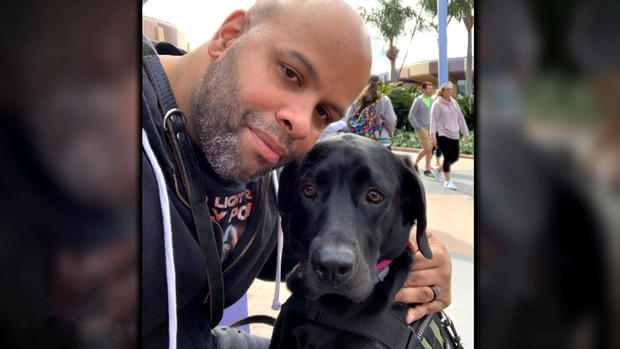
Army Sgt. Carlos Cruz with Hannah   CBS NEWS
Army Sgt. Carlos Cruz with Hannah   CBS NEWS

 To say retired Army Sgt. Carlos Cruz depends heavily on his service dog, Hannah, is an understatement. Cruz was diagnosed with post-traumatic stress disorder after returning from service in northern Afghanistan where he hunted for enemy explosive devices.

He acquired Hannah in January 2018 and says he’s thankful for her every day. “It’s amazing what she does for me,” Cruz told CBS News. “I don’t even know how she knows half the time. It’s like an unspoken language, I guess you could say.”

Scientists say there may be more to it than that.

About a 100 veterans and their service dogs are being studied by researchers at Purdue University of Indiana. As part of the unprecedented study, Cruz collected his saliva three times a day for three straight days this month to test his stress hormones.

He also dons a wrist-band to track vital signs Hannah may actually be affecting and Hannah gets tracked, too. They’ll be tested again in the summer.

“I think there are people out there who question whether or not service dogs actually help and they are looking for numbers and science,” Dr. Maggie O’Haire told CBS News. O’Haire leads the Organization for Human-Animal Interaction Research and Education, a research group at Purdue that has undertaken this project.

O’Haire and her team are trying to find out if there is a chemical reaction service dogs ignite in their owners and vice versa — findings which could say for certain that dogs can help and why.

Cruz can’t define it, but he knows Hannah helps.

“Sometimes just feeling her heartbeat and her breathing helps to calm me,” he said.

Watch the whole story at Scientists study how service dogs help veterans cope with PTSD on CBSnews.com.

Recent Stories

DVM and Veterinary Technology students gain job opportunity insights at fall PVM Career Fair

Purdue Veterinary Medicine's Fall Career Fair brought veterinary and veterinary technology students together with employers on October 30 at the Purdue Memorial Union. Students explored career opportunities, internships and externships while meeting representatives from veterinary practices and organizations.

In Memory: Dr. Mary Beth Leininger (PU DVM ’67)

Purdue Veterinary Medicine remembers Dr. Mary Beth Leininger (DVM 1967), who died November 6, 2026, at age 83. The first woman elected president of the American Veterinary Medical Association, she spent nearly three decades in private practice and held leadership positions in veterinary medicine, industry and education.

“Paws Up” for Kayla Fuqua – brought to you by the PVM Wellness Committee

Kayla Fuqua, the day-shift Emergency and Critical Care receptionist at our veterinary hospital, is this week's Paws Up honoree. A colleague recognized her for supporting clients, coworkers and veterinary students, answering questions and helping her department during busy shifts.

MMAS Symposium at Purdue provides hands-on learning about Medicine of Mammalian and Avian Species

More than 80 participants joined Purdue Veterinary Medicine's 2026 Medicine of Mammalian and Avian Species Symposium on October 31 and November 1. Organized by the Exotic Animal Club, the two-day event combined presentations on exotic animal medicine with hands-on training in parrot handling, rabbit examinations, avian clinical pathology and other specialized topics.

Costumed characters boost Halloween spirits in Lynn Hall

Halloween brought Minions, the Lorax, Super Mario Bros. characters and plenty of other costumes to Purdue Veterinary Medicine. Students, faculty and staff celebrated with costume contests, trick-or-treating and a Halloween dessert competition in Lynn Hall, the Reed ADDL and the Veterinary Hospital.