
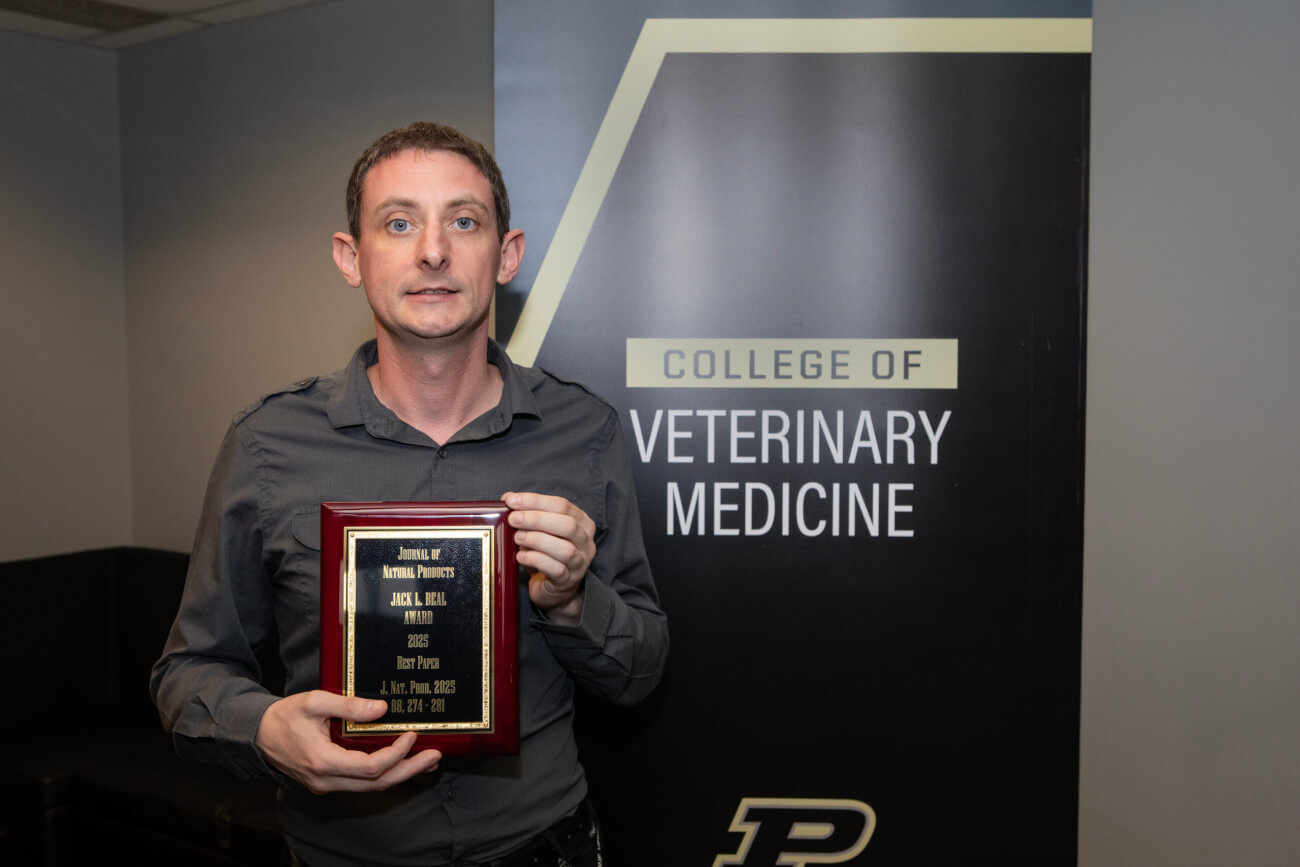
Dr. Christopher Rice, assistant professor of parasitology in Purdue Veterinary Medicine’s Department of Comparative Pathobiology (CPB), has been honored as the recipient of the 2026 Jack L. Beal Award for a paper published in the Journal of Natural Products. The journal, in partnership with the American Society of Pharmacognosy (ASP) and American Chemical Society (ACS), announced in September the recipients of the Beal Award and two other research awards – the Arthur E. Schwarting Award and the A. Douglas Kinghorn Award for Best Perspective or Review. The awards recognize the best papers published each year in the Journal of Natural Products.
Dr. Rice received the Beal Award, which honors early career investigators, for his paper, published in the February 28, 2025 issue, entitled, “Cyclic Peptide Natural Product Inspired Inhibitors of the Free-Living Amoeba Balamuthia mandrillaris.” Dr. Rice, who previously served as CPB’s section head of Microbiology, Immunology and Molecular Genetics, leads the Rice Research Group, which focuses on preclinical drug discovery and development, drug repurposing, diagnostic tool development, and host-pathogen interactions specifically for pathogenic free-living amoebae. This research includes some of the most neglected and almost always fatal diseases caused by Balamuthia mandrillaris, Acanthamoeba species, and Naegleria fowleri, which are more commonly referred to as the “brain-eating amoeba”.
Dr. Rice’s paper addressed Balamuthia mandrillaris, which is a pathogenic free-living amoeba (pFLA) that can cause infection of the central nervous system (CNS), called Balamuthia amoebic encephalitis (BAE), as well as cutaneous and systemic diseases. Patients infected with B. mandrillaris have a high mortality rate due to a lack of effective treatments. A nonoptimized antimicrobial drug regimen is typically recommended; however, it has poor antiparasitic activity and can cause various and severe side effects. Cyclic peptides exhibit a broad spectrum of antimicrobial activities but are underexplored for their antiamoebic activity. As explained in the paper, this study involved evaluating the anti-B. mandrillaris effect of Synthetic Natural Product Inspired Cyclic Peptides (SNaPP) mined from some 500 biosynthetic gene clusters of various bacterial species from Dr. Elizabeth Parkinson’s lab, also here at Purdue University in the Borch Department of Medicinal Chemistry and Molecular Pharmacology. The study is the first to demonstrate the anti-B. mandrillaris effects of cyclic peptides, offering a promising new direction for drug development.
Originally from the West coast of Scotland, Dr. Rice developed his interest in microbiology while completing his Higher National Certificate (HNC) and Higher National Diploma (HND) in biomedical sciences at Ayrshire College. He then continued his studies by pursuing a Scottish Bachelor of Science degree with Honors at the University of the West of Scotland (UWS). He graduated in 2010 with a focus on microbiology and immunology, and then went on to earn his Ph.D. in 2014. After coming to the U.S., he worked in various roles at the University of South Florida and the University of Georgia, where he developed high-throughput colorimetric and luminescent drug screening assays focused on Naegleria fowleri, Acanthamoeba species, and Balamuthia mandrillaris drug discovery. Dr. Rice came to Purdue in 2022 when he joined the College of Veterinary Medicine faculty. Since 2014 he and his lab have now screened more than one million chemicals in his search for new therapies against these debilitating and deadly amoebae.
