
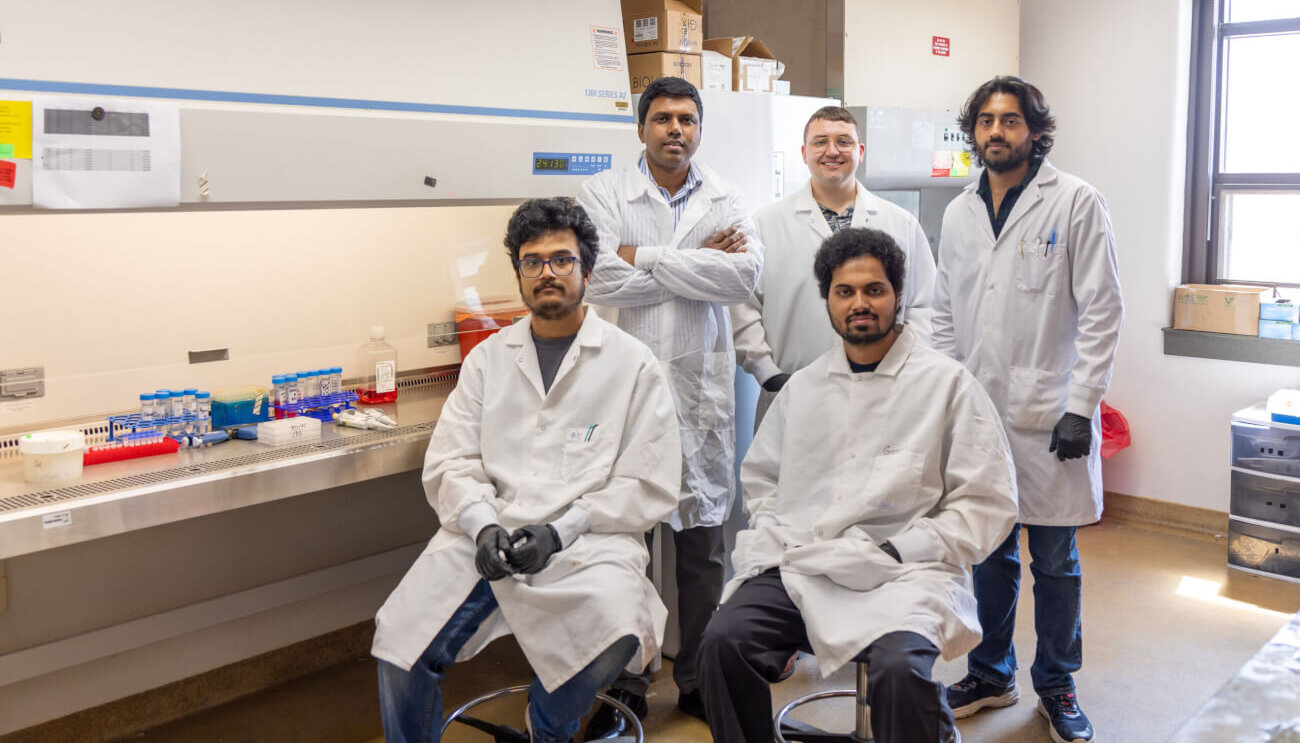
Though the name “Candida auris” is far from a household term, public health experts know it well because the multi-drug-resistant fungal pathogen, which causes serious human infections, has been classified as an urgent threat by the U.S. Centers for Disease Control and Prevention (CDC) Antibiotic Threats Report (2019). Dr. Shankar Thangamani, Associate Professor of Microbiology and University Faculty Scholar in the Purdue University College of Veterinary Medicine’s Department of Comparative Pathobiology, is researching C. auris, aided by a 2.4 million grant from the National Institutes of Health (NIH).
Research findings, just published in Nature Microbiology, show how C. auris adapts and evades the immune system. This study is a collaborative work by two labs: the Thangamani team at Purdue and the Traven team from Monash University in Melbourne, Australia. The study identified that C. auris uses nutrient sensing to tune its virulence traits and modulate immune activation in changing environments. In a glucose-rich environment, such as in the blood, C. auris suppresses its virulence traits and evades immune detection. Conversely, non-fermentable carbon sources prevalent in skin, such as lactic acid, activate adhesion and filamentation, thereby triggering macrophage responses. C. auris dials up or down its potential for virulence and controls proportional immune responses. Metabolic flexibility enables C. auris to optimize a critical trade-off: expressing virulence traits while minimizing immune recognition to colonize host tissues. These findings have significant implications in understanding how C. auris adapts within the host environment, which could open the door to developing novel antifungal therapeutics.
Previous work by the Thangamani team has also included two major studies published in PLOS Pathogens, a premier journal in host-pathogen interaction research. The researchers employed unbiased single-cell transcriptomics of murine skin infected with C. auris to identify cell-type-specific immune responses, as reported in a study published in PLOS Pathogens in 2024. In the subsequent study, Thangamani’s team found that, unlike Candida albicans, a closely related fungal pathogen that induces protective IL-17-producing T cells, C. auris predominantly induces IFNγ-secreting pathogenic Th1 cells during reinfection. The surprising conclusion was that IFNγ enhances skin infection by C. auris but not by C. albicans. These findings were also published in PLOS Pathogens in 2025.
Dr. Thangamani said these results enhance the understanding of host defense and immune evasion mechanisms during C. auris skin infection, which aids in understanding the pathogenesis of this emerging fungal pathogen and in developing novel antifungal therapeutics to prevent and treat C. auris infections in humans.
