
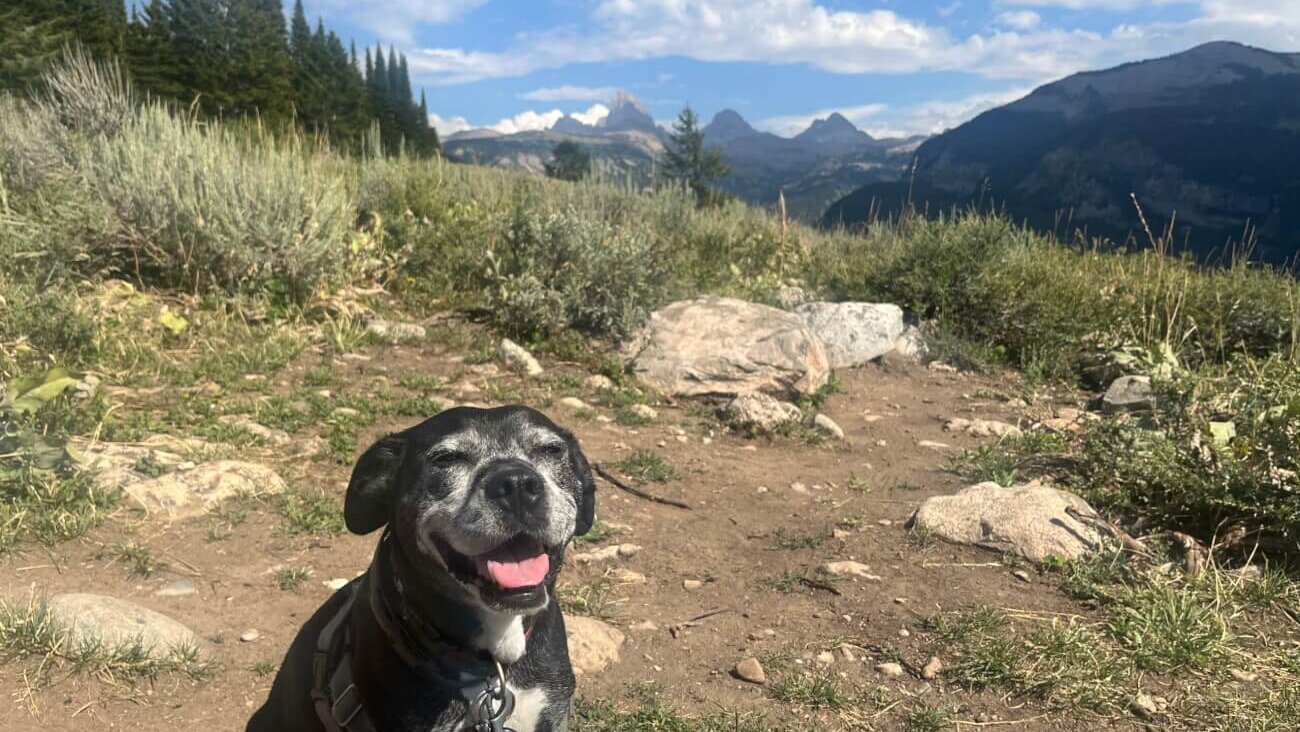
When Ella, a pittie beagle mix, was diagnosed with bladder cancer at age 11, Jennifer Turner knew she wanted to make every decision count. What she did not yet know was that a cross country drive to Purdue University would give her three more years with the dog she described as her constant companion.
Jennifer, originally from Michigan, had adopted Ella nine years earlier, after the dog was found on the side of a road. She named her after Ella Fitzgerald and sometimes dressed her as the jazz icon for Halloween. Ella had a distinctly human personality. She was highly attuned to people’s emotions and adapted herself to those around her. She was also an avid hiker and rarely strayed from Jennifer’s side.
After moving to Seattle, Jennifer noticed something unusual during a hike. Ella suddenly ate something off the trail — a behavior that was completely out of character. Looking back, Jennifer believes it was as if Ella was trying to force the issue, as though she knew something was wrong and needed attention. Soon after, gastrointestinal upset led to further testing and an unexpected diagnosis. Ella had early-stage bladder cancer.
Surgery at Oregon State University successfully removed a small mass, and Ella was asymptomatic afterward. In assessing whether to opt for chemotherapy as a follow-up treatment, Jennifer began researching other options. She quickly found Dr. Deborah Knapp at the Purdue University College of Veterinary Medicine in West Lafayette, Indiana. During spring break, shortly after the COVID vaccine became available, Jennifer drove Ella from Seattle to Indiana to be seen by Dr. Knapp, who later shared that Ella was one of only a small number of dogs she had encountered whose bladder cancer was detected at such an early stage. Rather than starting chemotherapy immediately, she recommended close monitoring and Deramaxx, selected to minimize stress on Ella’s other organs.
For Jennifer, the visit brought clarity and relief. “I finally spoke with someone who had managed a case exactly like Ella’s,” she said. “I left Purdue feeling like we had a plan.”
Dr. Knapp agreed to follow Ella’s case remotely, and exchange notes with Jennifer’s local veterinarian. Every six weeks, Ella underwent ultrasounds to monitor for changes. She remained active, fit, and enthusiastic about hiking.
Over time, bloodwork showed kidney stress which could have been related to one of her medications. Adjustments were made, but ultrasounds of the urinary tract eventually revealed tumor growth in a different part of the bladder, in a location where it could not be surgically removed. Jennifer continued returning to Indiana whenever possible to meet with Dr. Knapp.
When Jennifer elected to have Ella receive radiation therapy, she pursued that at Colorado State University, and Ella went there at the end of 2022. Ella tolerated radiation well during the treatment.
As the cancer continued to progress Dr. Knapp recommended chemotherapy. Jennifer was initially afraid, but by that point her trust in the Purdue team was unwavering. Ella received chemotherapy, and continued to enjoy life for several more months.
Unfortunately, over time the cancer spread and became resistant to therapy. Ella passed away in January 2024.
In total, the cancer treatments extended Jennifer’s time with her dog by three years. She describes that time as deeply restorative, made possible by a knowledgeable and compassionate team that allowed her to focus on Ella’s comfort and joy rather than feelings of uncertainty.
Recently, Jennifer shared a small token of gratitude. She had made sweatshirts featuring a photo of Ella on a hike and sent them to Dr. Knapp and members of the oncology team.
The gesture was simple, but it reflected feelings of gratitude that run deep, and the lasting impact of expert care given with heartfelt compassion.
