Purdue Highlights PVM Equine Research and Dr. Laurent Couëtil in One Health Feature
As Purdue focuses attention on research that is part of the university’s One Health strategic initiative, the spotlight is shining on Purdue Veterinary Medicine studies linking animal health with human health. One example, highlighted by the university this week, involves equine asthma research explained in an article by Purdue Brand Studio Senior Science Writer Brittany Steff.
Ask a person to picture someone with asthma, and despite famous asthmatic athletes including David Beckham and Emmitt Smith, they’ll likely picture a knobby-kneed kid clutching an inhaler on a park bench.
They certainly won’t picture a horse — and yet, a surprising number of horses struggle with asthma. Now, veterinarians are studying the condition to help horses and humans alike. Dr. Laurent Couëtil, an equine veterinarian and horse respiratory expert at the Purdue University College of Veterinary Medicine, studies asthma in horses, which has relevance for advances in human health.
Asthma afflicts nearly 1 in every 12 people in America, including 5 million children. It is one of the most common and costly human diseases in the U.S.
As it turns out, asthma in horses is much easier to study, leading to insights that may guide the way to therapies and treatments to help both humans and horses breathe easier.
“There are so many similarities between asthma in humans and asthma in horses,” Couëtil said. “Children tend to have a type of asthma we call atopic asthma, which they tend to grow out of. We see that same kind of asthma in very young horses, but not in older horses. In older horses, and in humans, one of the biggest triggers for asthma is dust in the environment. And that’s what we’ve found over and over again — it’s the dust. Managing that dust and medicating the symptoms are what we work on.”
As a member of the College of Veterinary Medicine faculty, Dr. Couëtil serves as a professor of large animal internal medicine, director of the equine research program, and director of the Donald J. McCrosky Equine Sports Medicine Center. His research is part of Purdue’s One Health initiative, which is a presidential initiative that involves research at the intersection of human, animal and plant health and well-being.
A gift horse
Couëtil, who grew up on a horse farm in Normandy, France, and colleagues formally identified equine asthma as a distinct condition in 2016. Asthma is an inflammation of the airways: they fill with mucus and swell, making it difficult for the body to get the oxygen it needs to live.
Asthma is notoriously difficult to diagnose because it is so easy to confuse with other conditions. In humans, diagnosis often involves tests measuring lung capacity, known as “peak flow tests,” which require the patient to take the deepest possible breath and blow the breath out for as long and as hard as possible to measure the amount their lungs can hold. Couëtil also developed a “peak flow test” for horses; however, it can only be done in his research laboratory and requires the horse to be sedated.
But peak flow can vary due to a variety of conditions that have nothing to do with asthma: time of day, muscle condition, energy level, mood, stress, hormones, general well-being and whether the patient is currently in an asthma flare-up.
One of the only surefire ways to assess asthma is to conduct a test called a bronchoalveolar lavage, or BAL, a procedure that doctors and veterinarians also call a liquid biopsy. The process involves putting a long, thin, hollow tool down through the patient’s airways into their lungs and pumping saline through it, then sucking the liquid back up. The returned liquid includes cells from the lining of the lungs. When analyzed, those cells can tell veterinarians and doctors a great deal about the state of the pulmonary system — including whether the patient has asthma.
In humans and most other animals, this procedure can only be performed under deep sedation or general anesthesia. However, due to their unique anatomy, horses can undergo a BAL while they are awake and under only light sedation.
The ability to conduct a BAL in field conditions gives veterinarians a diagnostic capacity that human doctors treating asthma lack. They can directly assess what conditions aggravate the lung cells and to what degree. Studies of asthma in humans must rely on larger sample sizes, much larger datasets and much greater variances in the data to get similar confidences in their results.
While humans and horses do not share one-to-one correlations on what causes asthma, Couëtil’s research on horses illuminates sources of irritation as well as some preliminary possible treatments. The links could offer powerful insights into drivers of asthma in both horses and humans.
Healthy as a horse
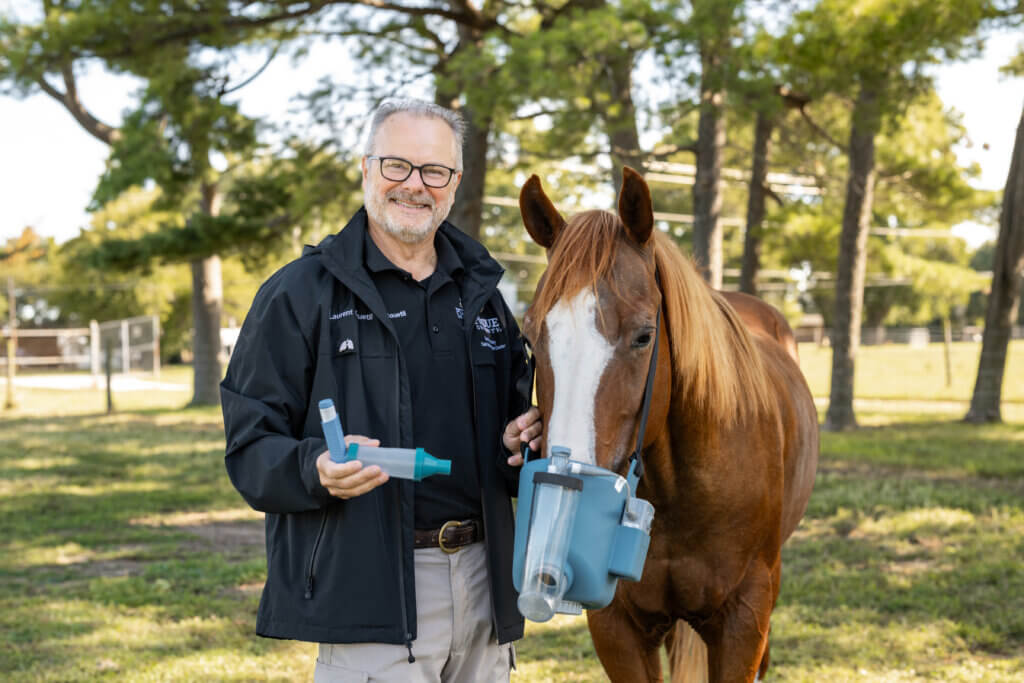
In the middle of an asthma flare, often called an asthma attack, the first course of action is rescue — opening the airways and calming the inflammation. For a human, that’s usually accomplished with a handheld inhaler. Since horses lack thumbs, Couëtil and his team use a nebulizer strapped to the horse’s nose to deliver corticosteroids and bronchodilator medication — often the same medication used to treat a human asthma attack. Like a toddler or an infant who needs a nebulizer rather than an inhaler, horses need either a nebulizer or an adapter to use the same inhalers that humans with asthma use, since neither can consciously coordinate their breathing with the medication distribution.
Calming the inflammation before it gets to the point of emergency is a priority. One promising substance Couëtil and his team are investigating is fish oil rich in omega-3s.
In a double-blind study conducted with the help of racehorse trainers in Indiana, California, New Mexico and Florida, Couëtil’s lab tested a fish oil supplement in nearly 100 horses’ food to see if the omega-3 oils might help calm the inflammation in the lung cells in a way that helps ameliorate their asthma symptoms.
Horses fed with fish oil had reduced lung inflammation within four weeks, while horses fed with a look-alike placebo oil — to fool horses and suspicious trainers alike — saw none.
Additional studies are needed to see if the link continues to hold true in humans, though research by other teams is encouraging. But such a strong preliminary result is promising, exciting and enticing.
“The goal is better breathing,” Couëtil said. “If we can understand what’s causing the inflammation, the driving causes, we can reduce it. And a lot of the same things work in humans as in horses.”