
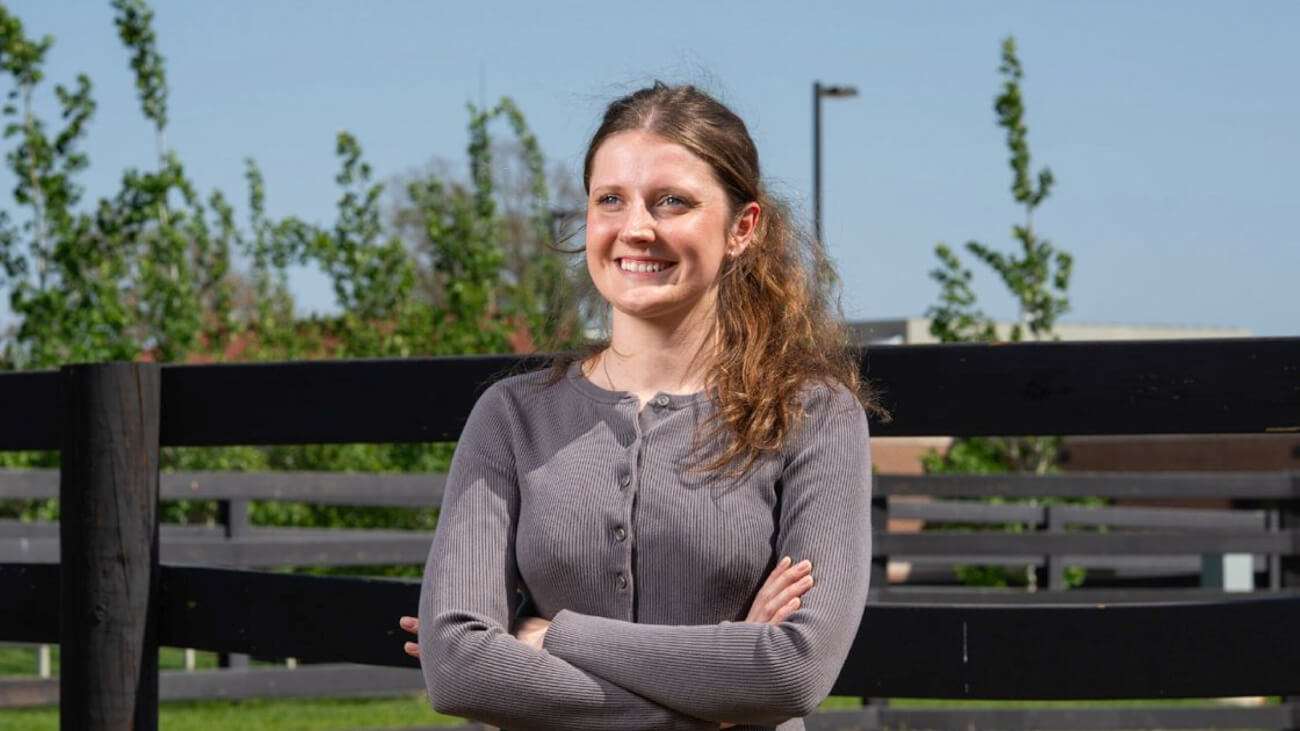
With help from the Purdue Veterinary Hospital, a graduating senior in the Purdue College of Agriculture mastered the answer to that question through practical experience.
The Purdue University Veterinary Hospital offers specialized medical care to both small and large animals often using outdoor areas like paddocks and dog runs. At first glance, these areas might seem like just a fence and a patch of grass. In reality, these spaces must fit within existing landscape features, provide biosecurity, be able to withstand heavy rains and be comfortable in hot weather.
Over the past semester, Mary Schultz, a senior in horticulture and landscape architecture, has worked with the veterinary hospital to reimagine its outdoor spaces and brainstorm solutions for the landscape’s technical, maintenance and aesthetic issues.
Schultz met regularly with her capstone advisor, Aaron Thompson, and Purdue Veterinary Medicine’s Director of Hospital Operations Joey Woodyard. From there, her capstone project and partnership with the veterinary hospital grew.
“There was a lot of creative freedom,” Schultz said. “Joey and the team really allowed me to create a vision and bought into that early on. It was awesome to have the reins creatively while also looking to meet some of their technical needs.”
The project required careful consideration. How does rainwater flow and collect? How much does the land slope, and how does that contribute to soil erosion? How much shade cover is there?
With this information, Schultz developed a plan for appropriate planting material, increased animal enrichment and safety while looking to establish the site as a campus destination. She included features such as a non-toxic planting with colors animals can see, relocating trees and adding shelters and custom seating elements, one of which highlights the Purdue College of Veterinary Medicine.
Woodyard has been impressed with Schultz’s ability to address the landscape’s practical and aesthetic needs.
“We have an issue in our horse paddocks with the turnover of sod creating a muddy mess as the spring showers hit,” Woodyard said. “Mary looked at it, went back, did research and came back with a whole proposal for how we could completely change the aggregate that was underneath the soil and create permanent solutions to our concerns. I think it could not only save money in the long term but also provide additional safety for our equine patients that are there using the space.”
Schultz also added features for students and staff, like an amphitheater for programs, scenic seating areas, well-defined entry points and art features.
“There are so many people who use this building every day, and yet, most of the time they are leaving the complex to go to other spaces on campus,” Schultz said. “I wanted to create a place where the people who work here can stay, visit and use while they go about their day-to-day activities.”
Schultz is excited that her project could mold the campus landscape and feels it’s a good ending to her undergraduate studies.
“When I was little, my parents used to find me climbing trees and building little fairy houses. I’ve always loved making things and being outside,” Schultz said. “I think that it’s true that what you like to do when you’re a kid can translate to your career growing up.”
Woodyard thinks the veterinary hospital also benefited from the project. “It’s been a very enlightening experience, both for me and for her. I was thrilled when the recommendation came that we could work with a student on their capstone project. It was a unique opportunity to take the skills that she’s been learning in her coursework and apply them to a real-world situation that could ultimately have a lasting legacy here at Purdue.”
The results of the capstone project will be provided to the College of Veterinary Medicine for its consideration in future planning.
Click here to view a video feature on Mary Schultz and her Senior Capstone Project for Landscape Architecture. Click here here to view a complete story with additional pictures.
