
Team Led By PVM Scholar Pioneers AI Application and Use of Large Canine Database to Advance Cancer Genetics Research

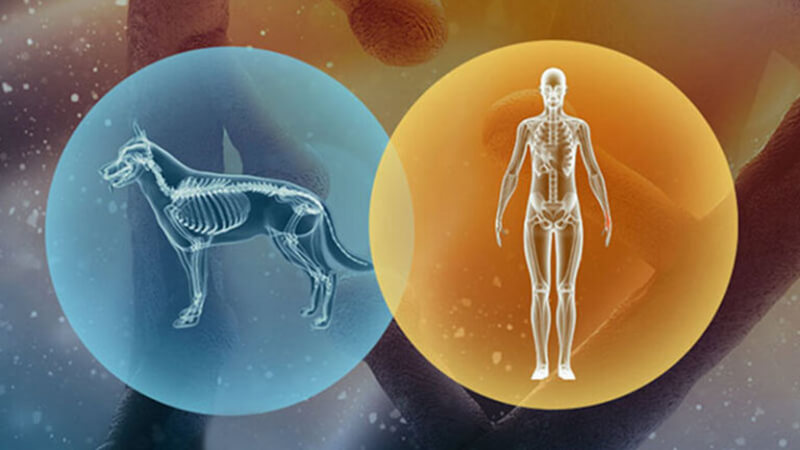
illustration of cellular level with connected scans of a dog and a human in the foreground
Photo courtesy of the National Cancer Institute’s Integrated Canine Data Commons

A Purdue University study’s novel use of an artificial intelligence model has revealed that biological pathways leading to cancer in dogs and humans are more similar than previously known. The research, led by a College of Veterinary Medicine faculty member, demonstrates enhanced value in studying naturally occurring cancer in dogs to learn more about how to defeat cancer in humans.

The findings, recently published in the journal Frontiers of Oncology, also showcase the value of large, accessible databases, such as the National Cancer Institute’s new Integrated Canine Data Commons (ICDC), which Purdue is helping to populate.

In the study led by Dr. Nadia Lanman, research associate professor of comparative pathobiology, a model developed at the Frederick National Laboratory was trained using data from The Cancer Genome Atlas, a large study of many different types of human tumors, including bladder and brain tumors (gliomas). The model was then used to predict the presence of the same types of cancers in dogs by analyzing cancer sequencing data from dogs with brain or bladder cancer. The results showed that human and canine tumors are similar at the genetic level and that the difference between bladder tumors and brain tumors can be discerned by protein-producing genes. The findings provide added evidence that genetic studies of dog cancer can help us learn more about human cancer.
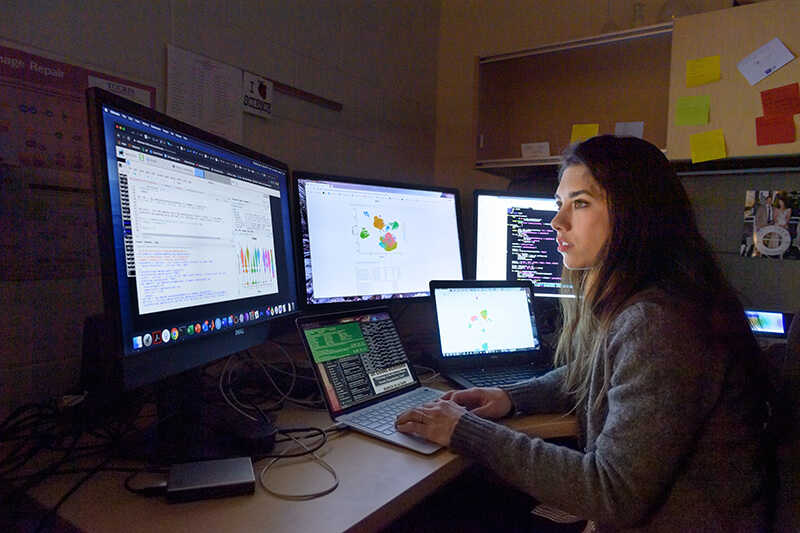
Dr. Lanman works on multiple computer screens in her office
Dr. Nadia Lanman, research associate professor of comparative pathobiology, uses artificial intelligence to study and analyze cancer research data. (Purdue University photo/John Underwood)

“We took an AI approach, specifically a deep-learning approach, to probe gene expression profiles of cancers that occur in both humans and dogs,” said Dr. Lanman, who also is a member of the Purdue Institute for Cancer Research (PICR). “We built two primary tumor classification tools across species. We tested a number of different machine-learning methods and a convolutional neural network called TULIP ended up being the most powerful and accurate approach we tried.”

A convolutional neural network is an algorithm inspired by the way human brains process visual information. It’s effective at finding and analyzing visual patterns using a large dataset of labeled images. It then trains itself to associate certain patterns or features in the images with specific labels or categories.

The effectiveness of such technology underlines the importance of databases and emphasizes that the largest datasets get the most robust and reliable results. The ICDC database was established to be an ever-expanding dataset capable of advancing research on human cancers through comparative genetic analysis with canine cancer.

“ICDC is a big deal because it’s a place where scientists all over the world can deposit and access data on canine cancer,” said Dr. Deborah Knapp, Purdue Distinguished Professor of Comparative Oncology and the Dolores L. McCall Professor of Comparative Oncology in the College of Veterinary Medicine’s Department of Veterinary Clinical Sciences. Dr. Knapp is one of the study’s co-authors and serves as the director of the Evan and Sue Ann Werling Comparative Oncology Research Center. “Researchers can use ICDC to pull in genetic data from dogs and genetic data from humans and analyze them simultaneously.” Dr. Knapp, a PICR member who also chairs a steering committee for the ICDC, said the database holds great promise for advancing canine and human cancer research. “It will be serving an even bigger purpose in the future — to group some cancers by their genetic makeup more so than by the organ in which they started. We are not there yet, but it is definitely a goal we can reach in the future. It’s advancing cancer genetics, which is the most important aspect of this.”

Writer(s): Amy Raley, Purdue Marketing and Communications | pvmnews@purdue.edu

Recent Stories

Indiana FFA Names PVM’s Julia Wickard as One of Five New Board Members

Executive Director of the Purdue Veterinary Alumni Association and Constituent Liaison Julia Wickard is one of five newly named members of the Indiana FFA Foundation board of directors.  The appointments took effect July 1.

Alumnus and Oncology Specialist Dr. Christopher Fulkerson Appointed as Associate Dean for Purdue Veterinary Hospitals

Purdue Veterinary Medicine Dean Bret D. Marsh, DVM, has named Dr. Christopher Fulkerson as Associate Dean for Clinical Affairs and Chief Veterinary Officer for the Purdue Veterinary Hospitals. The appointment was announced July 1, the same day that Dr. Fulkerson’s promotion to full Clinical Professor of Veterinary Medical Oncology took effect.

“Paws Up” for the ADDL Accessioning and Molecular Teams – brought to you by the PVM Wellness Committee

This week, we express our sincere gratitude to our ADDL Accessioning and Molecular Teams (and cross trained individuals).

PVM Dean Bret Marsh Shares College Update with Swine Producers and Industry Partners at Major Swine Event in Indianapolis

Swine Health was the focus of a significant event recently at the Indiana State Fairgrounds in Indianapolis as swine industry partners and swine producers gathered for the National Junior Summer Spectacular (NJSS) and Summer Type Conference (STC).  The event was held at the end of June in the Fall Creek Pavillion and included a Swine Health Briefing that featured swine industry and veterinary medicine leaders including Purdue Veterinary Medicine Dean Bret Marsh, who also had an opportunity to provide an update on the College of Veterinary Medicine.

2026 Annual Recognition Ceremony Honors VCS Residents, Graduate Students, and PVH Interns

On Monday, June 29, 2026, more than 100 faculty and staff from the Department of Veterinary Clinical Sciences and the Purdue University Veterinary Hospital gathered at Thomas Duncan Hall for the 2026 Resident and Intern Recognition Ceremony. This annual event provides a great opportunity to honor and celebrate the contributions of the residents, interns, and graduate students who are completing their programs this summer.

New Administrative Assistant Joins PVM Office of Student Success

The Purdue University College of Veterinary Medicine welcomes Charity Holden as the new administrative assistant in the Office of Student Success.

“Paws Up” for Scott Fix – brought to you by the PVM Wellness Committee

This week we are highlighting Scott Fix who is the Lead Facilities Manager in the Department of Veterinary Administration.

Remembering Zeus: A Legacy of Loyalty and Love

We continue our series of articles about animals and their owners who’ve found help and healing at the Purdue University Veterinary Hospital by sharing the story of a beloved dog named Zeus. For Amy Fitzsimmons-Blaising, Zeus wasn’t just a dog, he was her spirit animal and best friend. A proud Giant Schnauzer bred in Bedford, Indiana, Zeus had been the heart of Amy’s home for 11 unforgettable years. Then, in October 2024, Zeus’s health challenges began, when he started coughing and showing signs that looked like seizures. After rushing him to a local veterinary urgent care facility, Amy learned he was in congestive heart failure, and she turned to the Purdue University Veterinary Hospital for help.

PVM Scholar Receives Purdue WGHI Pilot Grant Aimed at Advancing Women’s Health

Purdue University’s Women’s Global Health Institute (WGHI) has announced six pilot research grant awards aimed at solving critical problems in women’s health and quality of life, and one of recipients is Purdue Veterinary Medicine faculty member Viju Vijayan Pillai. Dr. Pillai is assistant professor of anatomic pathology in the College of Veterinary Medicine’s Department of Comparative Pathobiology.

The universal socket set of vaccines: Innovative technology heralds more effective, more efficient vaccines

You fight fire with fire. And Purdue Veterinary Medicine vaccine expert Suresh Mittal fights viruses with viruses. Using innovative techniques, Dr. Mittal, Distinguished Professor of Virology in the College of Veterinary Medicine’s Department of Comparative Pathobiology, develops novel vaccines for viral infections including avian influenza.